
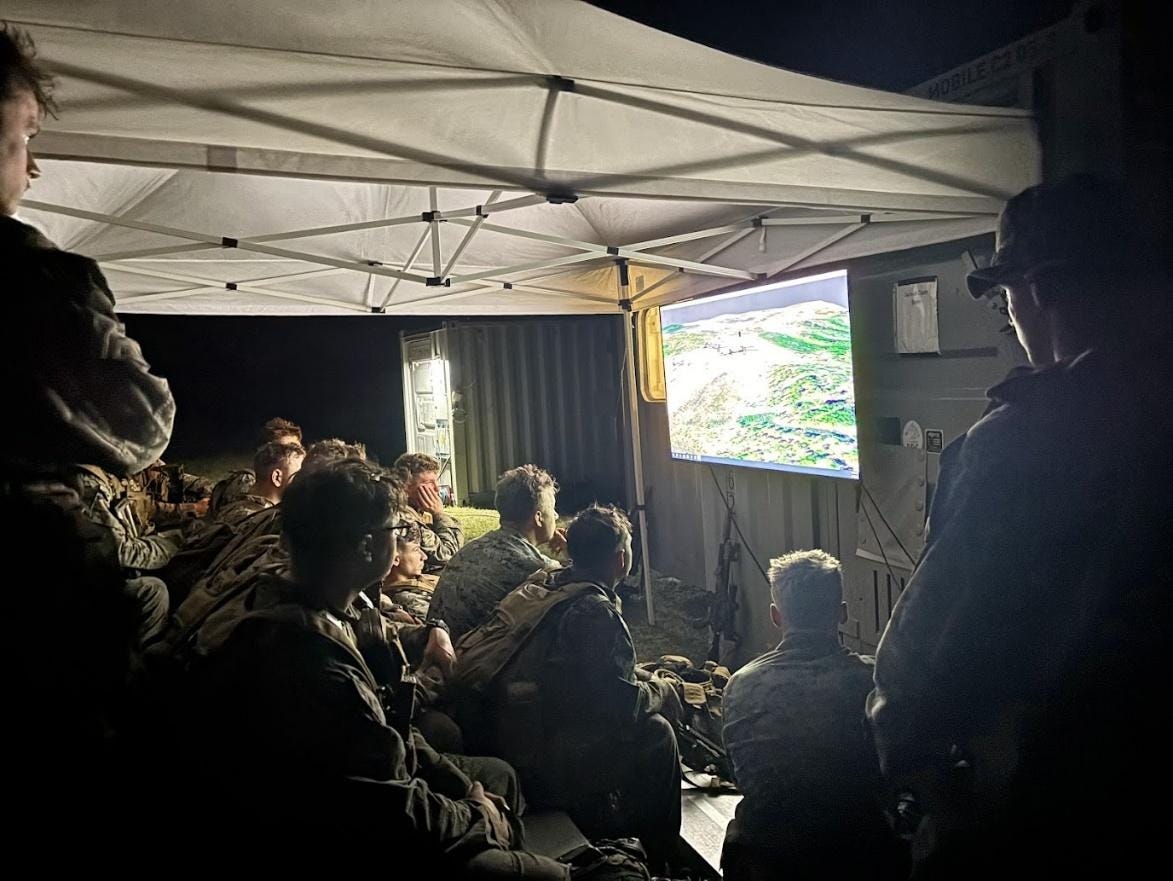
Thorough after-action reviews are the decisive advantage of force-on-force training. When enabled by systems such as the Marine Corps Tactical Instrumentation System (MCTIS), that advantage is magnified. MCTIS provides objective data on unit and individual movement, round expenditure, and the orientation of fires, allowing leaders to see not just what occurred, but how it occurred. This level of fidelity enables commanders to analyze actions down to the individual Marine, identify specific decisions and behaviors, and tie outcomes directly to tactics and execution. High-quality after-action reviews accelerate learning and dramatically improve subsequent iterations, which is why force-on-force training remains central to pre-deployment preparation. The question is not whether these after-actions are valuable; it is why we accept losing this level of feedback when we transition to live-fire training.
When planning collective training, commanders often frame the choice as one between live-fire exercises and force-on-force training. Live fire assesses marksmanship, lethality, realism, and the discipline imposed by real weapons and safety constraints. Force-on-force training allows greater freedom of maneuver, experimentation, and more comprehensive feedback through instrumentation. Both approaches are valuable, but each has inherent limitations. The most significant limitation of live-fire training is not realism or safety; it is the lack of high-fidelity feedback that allows units to understand how they fought and how to improve in future fights.
Do you remember the last time you evaluated a live-fire attack? You stood on the range with a Rite in the Rain, trying to capture key observations as the unit moved. You had a few focus points in mind, but as the attack progressed and the situation became kinetic, note-taking gave way to tracking the unit and ensuring safety. By the time the firing stopped, your notes were incomplete. Your assessment relied largely on memory. During the debrief, you attempted to reconstruct events in your head, recalling what you thought happened. You knew initiative was taken beyond the breach, but you could not say for certain which Marine drove the action or how the action unfolded. The AAR lost precision and its instructional value.
Poorly conducted or limited debriefs are all too common on live-fire ranges across the Marine Corps. Some units attempt to mitigate this problem by flying small unmanned aircraft systems to capture video of the attack. This is a step in the right direction, but the utility of sUAS remains limited. sUAS footage is weather-dependent, often supplying grainy video feeds, and provides little more than a visual record. Employing sUAS offers no automatic data on movement, fires, or individual actions. However, the Marine Corps already fields a system capable of producing detailed, objective after-action visual aids within minutes - MCTIS. A capability that, if used properly, can significantly enhance debriefs and provide evaluators with tangible feedback to deliver to Marines immediately.


Applying MCTIS to Live-Fire Training
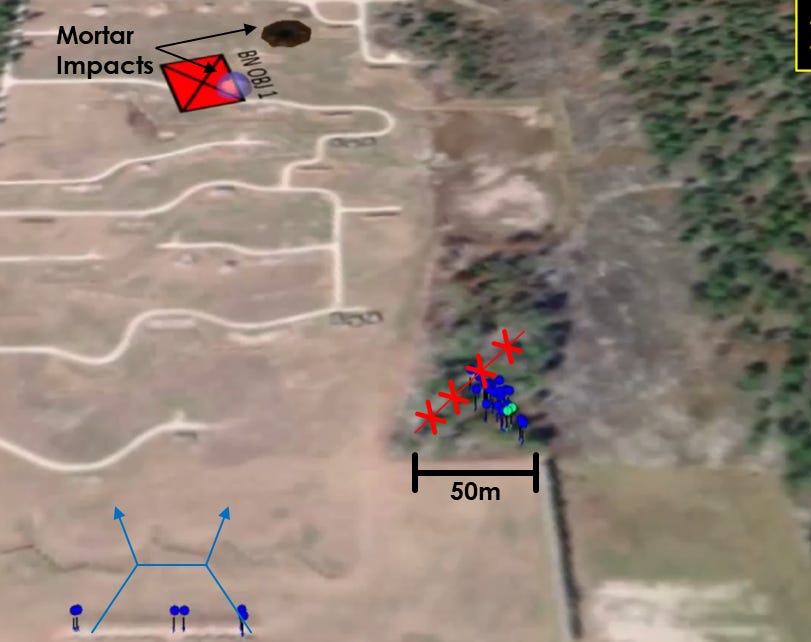
MCTIS is widely associated with force-on-force training, but its advantages apply to live-fire exercises. When integrated into live-fire attacks, the system enables immediate, objective feedback on unit and individual performance, eliminating reliance on memory or observer notes. In April 2025, V32 became the first unit at Camp Lejeune to employ MCTIS during live-fire platoon attacks. Every Marine wore the system throughout execution, and each iteration was reviewed immediately following the run. Although no opposing force was present, the video playback and data provided clear insight into movement formations, dispersion, and fire distribution, offering a level of after-action review typically unavailable in live-fire training.
The two focus points for these platoon attacks were the sequencing of events and effective suppression. The MCTIS-enabled after-action review enabled evaluators to address both with objective data, resulting in focused, relevant debriefs. The system clearly depicted when indirect fires began, when support by fire was established, and how those actions related to maneuver. In one iteration, the after-action showed that the unit delayed movement from the objective rally point until the completion of the entire mortar mission, disrupting the intended sequence. This delay was visible in both the data and the video, allowing the evaluator to coach the unit leader on the specific decision. The system also captured individual firing activity, allowing evaluators to show when fires were appropriately distributed and when maneuver occurred without adequate suppression. The labeling of individual Marines allowed evaluators to question specific decisions in real time and coach based on what each Marine observed. This level of detail enabled precise coaching tied to the stated focus points and resulted in improved execution on subsequent iterations.
Previous one-dimensional debriefs became interactive and analytical discussions. With the ability to watch their execution in real time, Marines proved more willing and able to explain their decision-making and explain what they observed during the attack. The video playback allowed Marines to show both the evaluator and the unit what they believed they had seen and to compare that perception with what actually occurred. This objective feedback corrected inaccurate assumptions and reinforced disciplined decision-making. The system’s individual accountability further motivated Marines to improve their performance and attention to detail on each iteration. By the end of the exercise, platoons were excited to attend the debrief to see how their run improved and identify shortcomings they could continue to address.
V32 Lessons Learned
While the integration of MCTIS into V32 live-fire training significantly enhanced after-action reviews, several planning considerations emerged that would further improve its effectiveness:
Unsuppressed. The MCTIS rifle sensor does not register rounds when suppressors are mounted. To accurately capture the distribution of fires and rates of fire, suppressors must be removed during live runs, which should be accounted for during training planning and zeroing.
Observation. The value of the after-action review increased when a dedicated evaluator monitored each run live from the MCTIS feed. This individual, ideally the S3A or another experienced officer with a firm understanding of the training focus points and small-unit tactics, was able to coordinate closely with the downrange evaluator and the MCTIS contractors. This coordination enabled more deliberate selection of critical moments for playback, ensured proper camera coverage, and helped identify trends across multiple iterations and platoons.
Power. Battery management requires deliberate planning, as systems need to be replaced approximately every 36 hours. When planned in advance, this requirement had minimal impact on execution and did not disrupt training flow.
One crucial observation bears emphasis: leaders must understand that the replay is not the after-action review. Allowing video to run without deliberate facilitation quickly degrades the debrief, shifts focus away from training objectives, and wastes time. For this reason, disciplined execution of the AAR is essential. A dedicated evaluator must deliberately select where to pause the replay and direct discussion toward critical actions, decisions, and errors. When used with intent, the video is a valuable asset. When used passively, it becomes a distraction.
Beyond AAR Benefits
While improved after-action reviews remain the primary benefit of integrating MCTIS into live-fire training, the system also enhances execution realism:
Built-in audio cues allowed Marines to hear simulated indirect fire impacts, reinforcing timing and coordination without additional observer controller input.
Casualties could be portrayed through the system, reducing the need for observer controllers to manually simulate battlefield effects.
Together, these capabilities reduced artificial range control inputs and allowed Marines to respond to feedback generated by the training environment itself rather than external direction.
Conclusion
At the time of writing, the rifle-mounted firing sensors discussed in this article are no longer approved for use by the Marine Corps Systems Command for the time being. While this limits the ability to capture individual rifle fire data in the near term, it does not detract from the broader argument for integrating MCTIS into live-fire training. The system continues to provide significant value through movement tracking, indirect fire visualization, and high-fidelity video playback. These elements enhance after-action reviews and learning during live-fire exercises.
By integrating MCTIS into live-fire training, commanders can preserve the psychological and physical demands of live rounds while gaining the analytical fidelity required for meaningful after-action reviews. For company and battalion commanders responsible for preparing Marines for combat, this integration represents a practical, proven, and immediately actionable improvement to training. The tools already exist, and we should employ them where they matter most.
Capt Blaine Mainz is an infantry officer and currently a student at Expeditionary Warfare School. He has previously written about sUAS employment at the platoon and company level. He can be reached at blaine.mainz@gmail.com.


Great article. Very compelling use of training systems to facilitate improvement; this is one of those "I wish we had that way back when". Using the MCTIS (or analogous systems) in live fire etc makes great sense for feedback and review. It's always nice to have practice tape. Telemetry has been a big part of motorsports for years. Figuring out to increase potential usage of telemetry for ground forces in training should be a front burner item. One note of caution though...everything is easier in playback.
Everyone should couple this article with alt Danko’s article on metrics. MCTIS can enable both the debrief and metric-gathering.
Great stuff, Blaine.