

“Guerrillas fight only when the chances of victory are weighted heavily in their favor… They rely on imaginative leadership, distraction, surprise, and mobility to create a victorious situation before battle is joined… Attacks are sudden, sharp, vicious, and of short duration… The mind of the enemy and the will of his leaders is a target of far more importance than the bodies of his troops.” FMFRP 12-18 Mao Tse-tung on Guerrilla Warfare
Editor’s Note: This is an installment in our Decision Making Exercise (DMX) Series. Send your solutions to cxfile0302@gmail.com or drop in the comments for a chance at publication.
This is a three part problem. Do not advance until you have completed each section.
Part A
You are a rifle platoon commander, in Company A, 1st Battalion, 7th Marines. For two months, you have been fighting on the mountainous and densely populated pacific island of Formojra against a Threat Charlie type force. Things have not gone well. Since the opening stages of the conflict, allied forces have continuously been on the back foot. Enemy ISR makes it extremely difficult to mass forces without being targeted. The enemy’s mechanized infantry and armored formations, in conjunction with their rotary wing aviation and fixed wing support have launched extremely well-coordinated and effective combined arms offensives. All-in-all, things are grim.
The only saving grace, and the only reason why allied forces have not yet been pushed off the island, is that the island’s natural and manmade terrain have allowed friendly forces to fight a punishing defense in depth, often trading space for time and defeating enemy penetrations with brutal and decisive counterattacks. Still, there can be no mistake that we are far from winning.
It is 2130. It has been raining continuously for weeks now. Between the rain and the sleep deprivation, you struggle to remember the last time you were dry. Your company commander (a close friend of yours who, until recently, was the company XO) calls you to his ad-hoc CP, built in the lower levels of a parking garage in the small village that your company occupies. He looks tired. He tells you the following:

“Recon teams and SUAS have reported indications and warnings of the enemy massing for another push in our AO. They must be putting together something big. They’ve been running at least one fuel convoy south to north along MSR Tennessee per day for the last three days. The fuel convoys have comprised of 2 IFVs in the lead, 5-6 fuelers and logistics vehicles in the main body, followed by another IFV bringing up their rear. Whoever they’re resupplying needs a lot of gas and a lot of spare parts.
It’s going to be a knife fight if we let them come right at us. We have to take their legs out from under them if we’re gonna stand a chance. We know their main battle tanks are no better than ours in terms of fuel economy. If we can knock out their refuelers, we can prevent this attack from getting off the ground and then clobber them in their assembly area. We just need time…
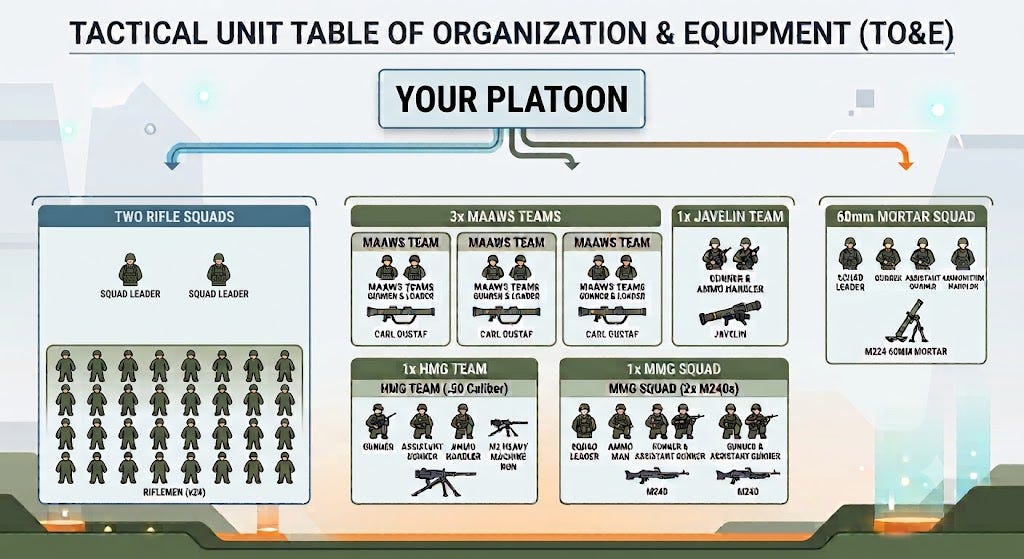
I need you to take your platoon and AMBUSH those refuelers to prevent them from reaching their assembly area and resupplying their MBTs. I can spare you a javelin team, a squad from 60s, an HMG team, and a MMG squad.”
“We’ll get it done” you say.
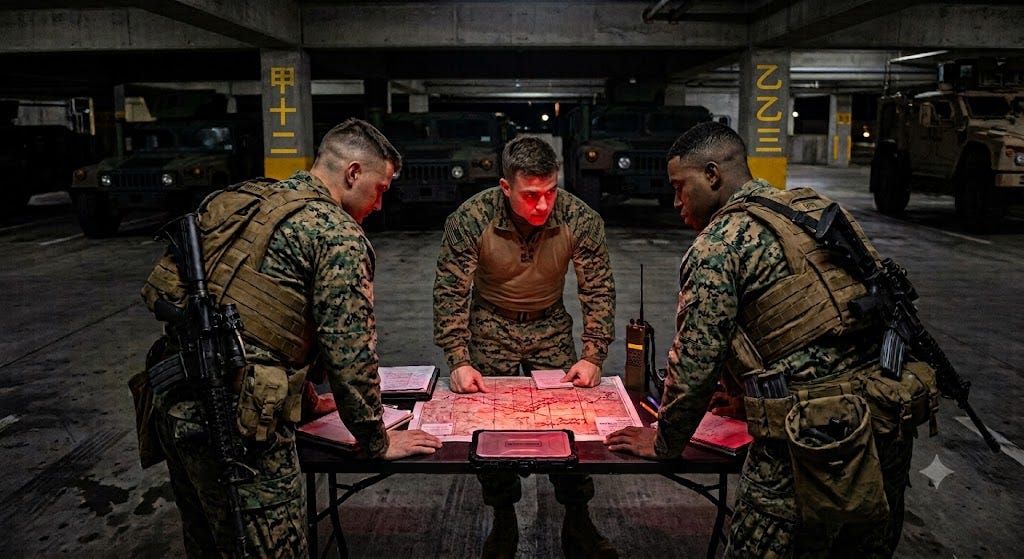
You head back out into the rain and walk to your platoon CP which you established in an abandoned pharmacy. Once there, you link up with your platoon sergeant, Sgt Yance, a Marine who used to be your first squad leader before your old platoon sergeant, SSgt James, was killed last week. You lay out the situation and work together on a map reconnaissance to formulate a plan. “At least the skipper didn’t shortchange us on weapons” says Sgt Yance as you both look at the map under a red lens. You identify a natural choke point along the MSR about 15 kilometers away from your current position.
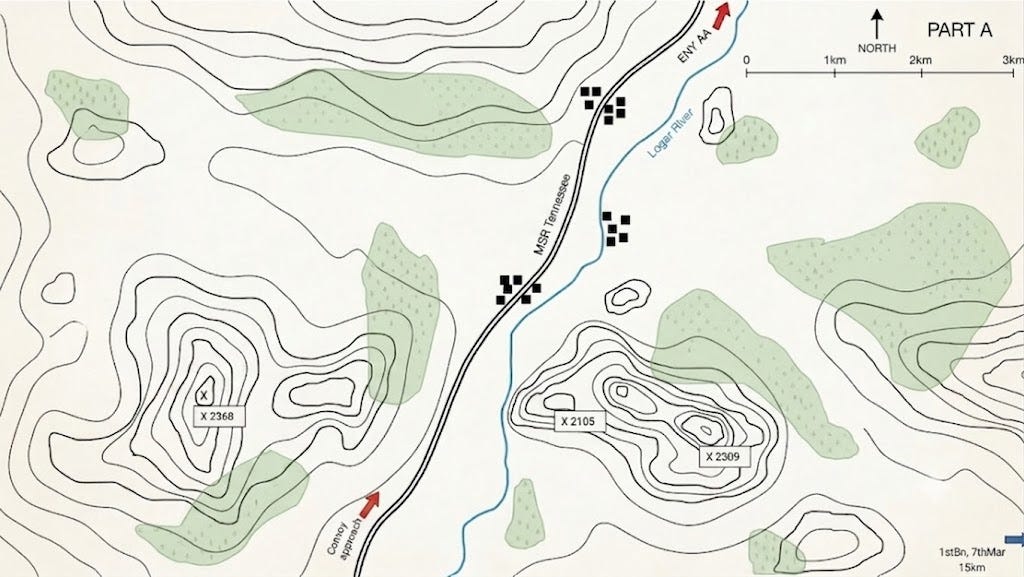
Develop your CONOPs, Tasks, and any Coordinating Instructions you might have. This must include a tentative ORP location. Depict your plan on your map.
Do not continue until you have completed your work.
Part B
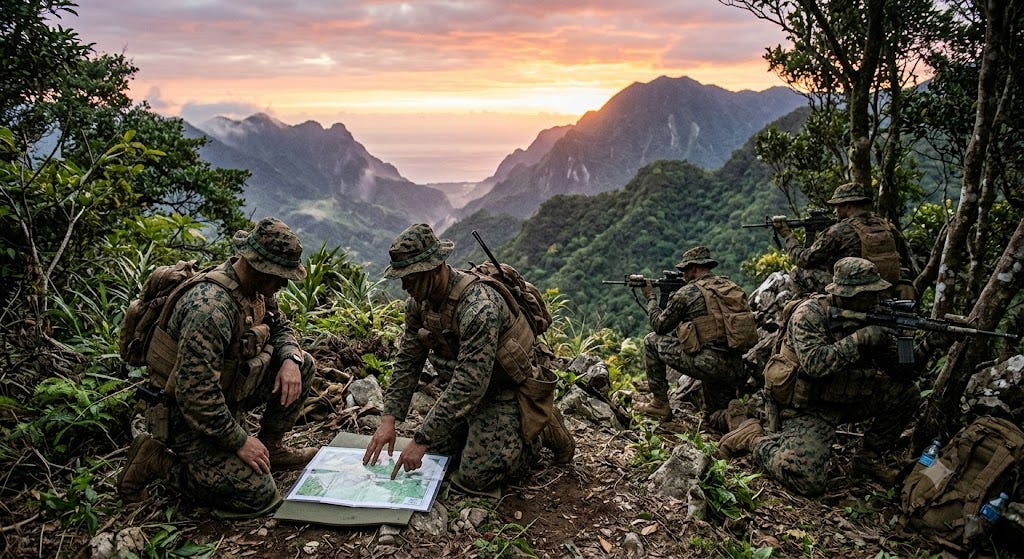
You reach the Objective Rally Point (ORP) with your platoon (+). To say the movement from the company area was challenging would be the understatement of the year. The 15km foot movement through the rugged terrain, carrying crew-served weapons, while seeking to manage your signature from enemy ISR was a battle in itself. You feel exhausted. Your Marines, though tired, performed admirably under the circumstances.
As your Marines set into their security, the rain begins to ease. You set down your heaviest kit, and strip down to a chest rig and your boonie. Your squad and weapons team leaders do likewise and your platoon sergeant supervises the placement of your platoon’s machineguns. You issue your GOTWA to your platoon sergeant. “We’ll be ready when you get back, sir.” You and your reconnaissance group head out.
45 minutes later, your group makes it to a prominent location in the area with excellent visibility. You scan MSR Tennessee. Much of the terrain is what you expected and you are able to quickly orient yourself to your exact location. The valley below is covered in grass at least three feet high, and three small villages generally line the road. The villages appear to be comprised of brick and stone buildings, none of which are more than two stories high. Pockets of thick treeline litter the area and you see plenty of micro terrain not depicted on the map that you think will allow you to refine the placement of your crew served weapons for maximum effect. You see the Logar River, which you figure is about chest deep at most.
As you continue to scan, you notice activity on a small hillock near one of the villages. You see approximately ten enemy soldiers working on improving a fighting position. As you study them, you see that the position looks to be deliberately constructed, although the quality of the position leaves much to be desired. They have sandbags and waist deep fighting positions covered by protective C-wire, but no overhead cover. They look relaxed, with some soldiers smoking cigarettes and some filling sandbags with their shirts off. The only two soldiers you can see in full kit are the two behind a MMG, themselves scanning the valley to the east.
Satisfied with your reconnaissance, and considering this newly discovered enemy position, you and your leaders make your way quietly back to the ORP.
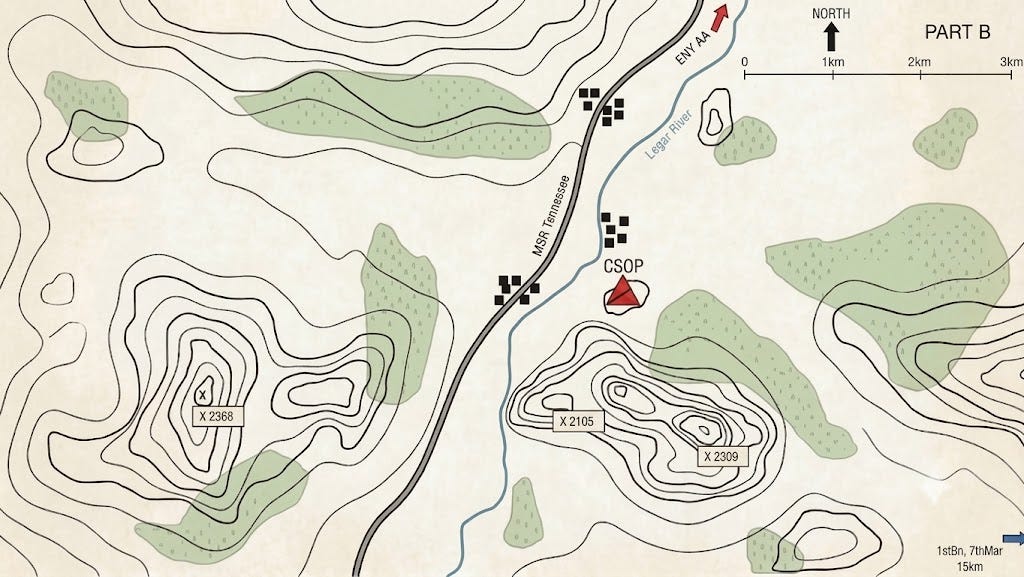
In a time limit of ten minutes, complete the plan and issue any changes to your scheme of maneuver.
Do not continue to Part C until you have finalized your orders.
Part C
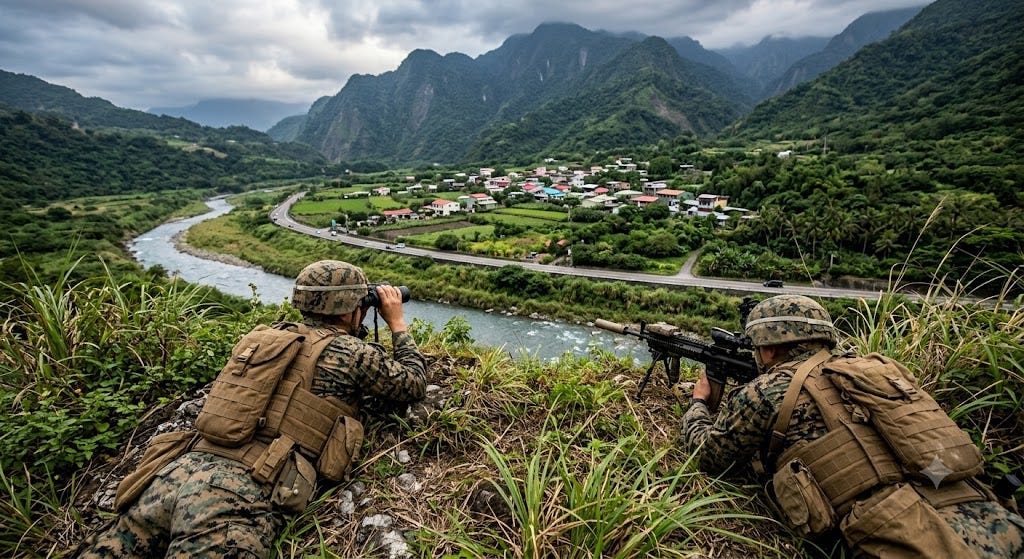
You issue your final orders to your leadership group and give them time to pass word to their Marines. About two hours later, you confirm that your Marines are in position. The ambush is set.
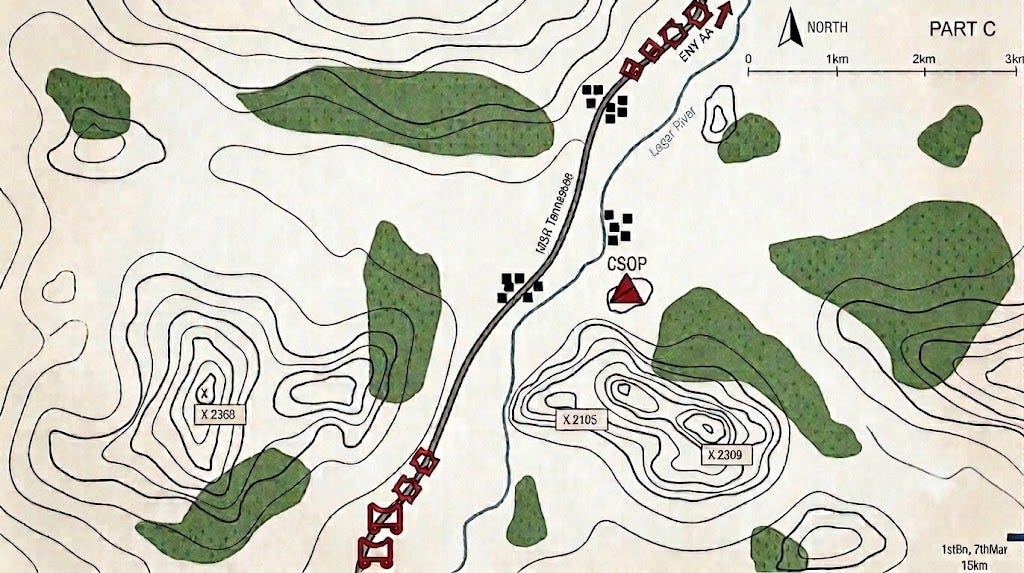
Another 50 minutes go by before one of your team leaders nudges you with his elbow and points down the road to the south. Around the bend you can see an enemy column approaching along the MSR from south to north. In the lead of the column are two infantry fighting vehicles. As they approach your kill zone you can count six, then seven, then eight, then nine refuelers and logistics vehicles with more on the way.
Your Marines are ready. You feel the tension in the air… and just as the lead IFVs are about to enter the kill zone, another one of your team leaders pulls you by the collar hard and forcefully turns your head to the opposite direction to the north.
From the north you can see two main battle tanks coming into view followed by several more infantry fighting vehicles.
What now, Platoon Commander?
1stLt Robert Gortner is the Executive Officer for Fires and Reconnaissance Company, 1st Battalion, 7th Marines.


Even better news. We have junior officers dedicated to mastering combined arms with all (weather) arms and not just one. This is why the Marine Corps infantry will continue to win.
too many people in the comments not having fun in the spirit of the TDG, thanks for putting this together, really cool thought exercise.
For Part A, same as anyone else, set a deliberate L-shaped ambush focused on the logistics vehicles, assuming type-04 IFV's we have the Javelin tm and a MMG tm go on the high ground southeast of the town; mortars stay in defilade east of the town behind the terrain. 1st Squad, two carl G's, and the HMG (strong backs lads) occupy the low ground east of the Logar River south of the high ground, while 2nd Squad, the remaining Carl G tm, and MMG position north of the kill zone astride the MSR so they can engage down the axis of advance. I’d also hold one fire team from each squad as an internal reserve for casualty handling, local reinforcement, and withdrawal support.
Part B changes the occupation plan more than the overall concept. The newly discovered enemy OP is a compromise risk, so 2nd Squad would deal with that position before occupying its final location. The rest of the platoon continues setting the ambush. The 60mm mortar supports that action, then shifts its attention back to the convoy. The point is to neutralize the security problem without letting it derail anything, IFV's go first in priority from the Javs because the fuel trucks wont move off road so we can trap them in the box
Part C: The tanks are not the mission, and if the river prevents them from directly pursuing across our withdrawal route, I would not get sucked into an unnecessary armor fight. We destroy as much of the fuel/logistics convoy as we reasonably can, then break contact before the mechanized force closes on us. MGs and mortars support the withdrawal while the platoon uses the river and terrain to create separation, reforms, and gets out with the force intact.