
Finding the Enemy at Bridgeport
by Capt Conrad Laurion and Capt Michael Boyle

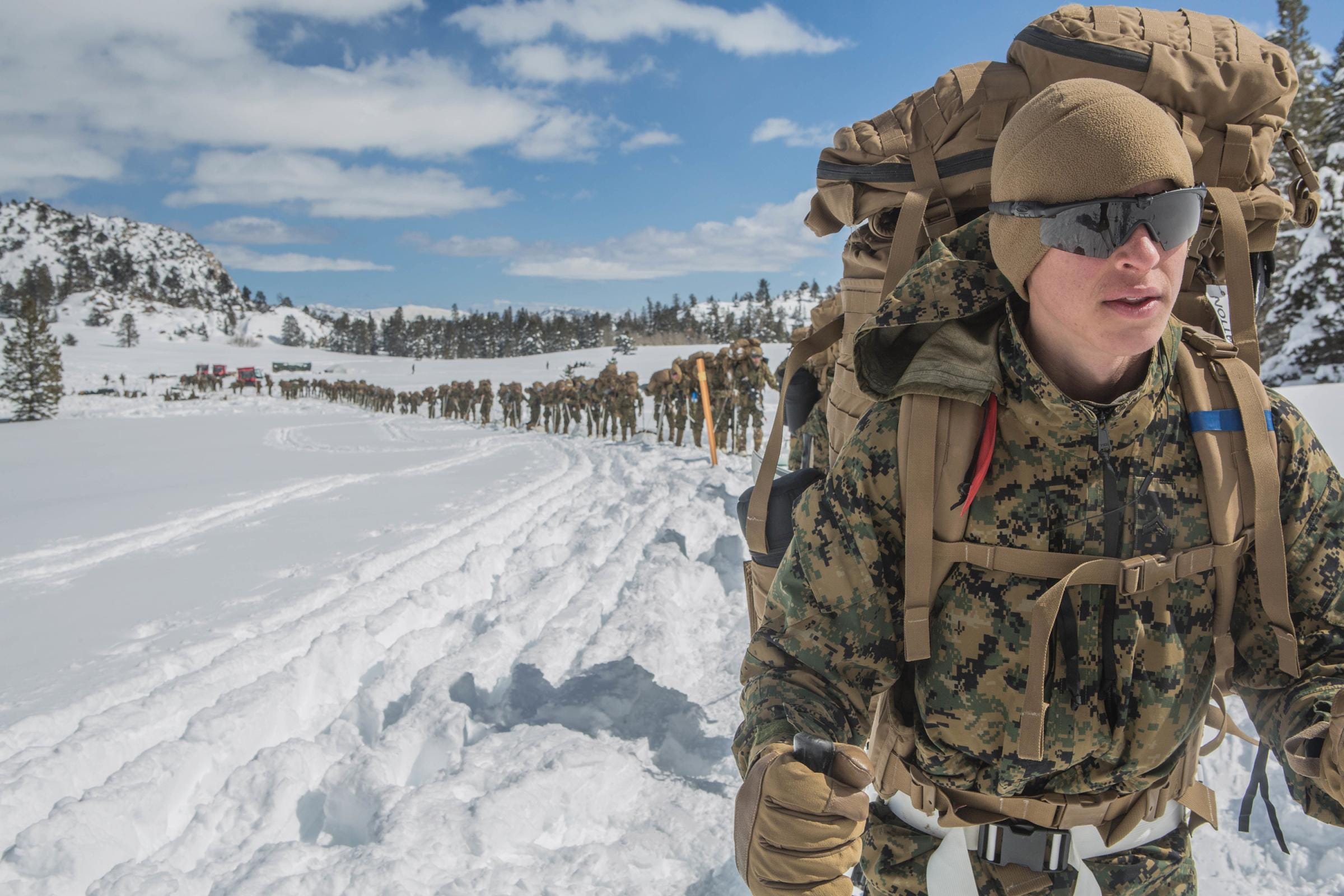
As the Marine Corps shifts to Force on Force (FoF) exercise design, an emerging trend can be seen aboard the Mountain Warfare Training Center: Infantry Battalions and Rifle Companies are unable to properly employ reconnaissance assets and basic scouting and patrolling techniques to locate enemy forces. During our Company Offensive Operations Lane (COOL) commanders are tasked to destroy an enemy platoon that is approximately five kilometers away from their TAA. The companies have two and a half days to locate the enemy position, fix them in place and develop a SoM to destroy an objective before they transition to the defense in preparation for a counter attack.
During the last 15 COOLs only one company was able to thoroughly reconnoiter the enemy position prior to their deliberate attack. The other 14 companies characteristically located the enemy by chance contact then launched a hasty attack against an enemy position with no intel or preparation. The enemy’s positions are often as complex as the trench system at R400. Companies that stumble into contact with the enemy have varying degrees of success aboard MWTC. Their success is linked to their rehearsal of battle drills. In a mountainous environment, it is difficult to build a flexible plan. It is even more complicated to remain flexible in execution due to the increased movement time in rugged terrain (i.e. it will take your reserve 90 minutes to hop a terrain feature and move into a position that they’re able to affect the battlefield, how many rounds and pounds of 7.62 is that?). This is why we emphasize a deliberate attack borne from a thorough reconnaissance of the enemy position. Ultimately, it is going to help that company retain its combat power, resources, and the lives of its Marines. Below are some of our observations that have helped units find the enemy:
Training:
Reconnaissance patrolling drills. Fire teams and squads are given a narrow corridor to maneuver through and tasked with finding an enemy patrol. This drives them to utilize fieldcraft and terrain to mask their movements. The objective is to locate enemy units and relay their positions back to higher without getting compromised. Units must then maintain visual contact and continue passing information to higher. This is a competitive way to practice scouting, tracking, field skills, communication and land navigation.
Close-in reconnaissance drills. Units are tasked with reconnoitering an NAI to confirm an enemy’s position. The purpose of this training is to locate and accurately record all of the fighting positions, CSW, HQs, etc. Fighting positions can be substituted for company vehicles, HQ PLT personnel and equipment. This can be facilitated during whitespace and should be against a force who is actively looking for them. Once they have all the positions mapped, have them relay it via radio to their higher.
LP/OP positions. Similar to the close-in reconnaissance, have your units disperse from your AA and construct LP/OPs to observe your location. Give them a time period and then bring the members back to observe the locations of each OP from the AA site. Build the complexity of this scenario and eventually have your Marines construct LP/OPs while people are trying to observe and find them.
Field skills and camouflage. Train your Marines on the Signature Management- Camouflage SOP (see saved rounds). At a minimum, Marines need to know how to conceal themselves, make a ghillie blanket, conceal a bivouac site, and construct an LP/OP position.
Planning:
Task Organizing. It is difficult to move in the mountains and a unit can deplete their combat power very quickly by conducting reconnaissance. We recommend task organizing a recon squad or platoon of your most fit Marines. They will be required to move fast and typically cover twice the distance of the main body. They should be able to do this for 24-48 hours and thoroughly scour an objective area. Creatively re-organizing your T/O and weighting elements with certain assets can give you a hybrid capability more useful than a rifle squad alone. Put one M240 and one PRC-150 with six grunts, a comm guy, and someone savvy at navigating and now you have a forward reconnaissance element that can move quickly, provide route recon/recommendations, comm relay, overwatch, target data, etc.
NAI development. The development of NAIs should be tied to enemy’s movement corridors that are generated from your IPB. Your CLIC should be able to create a MCOO. A trend we are seeing is NAIs that are not built with the collection assets capabilities in consideration (a 2x1 km NAI given to a platoon to observe.) This is too large for this asset. Refine your NAIs down to specific points; intersections, bridges, or chokepoints, that answer questions and confirm or deny assumptions made in planning, and then source them appropriately with the assets available to you; a ‘weapon-to-target match’ for your collections plan. This will help your squad leaders in their search of the specific points.
Reconnaissance management is Mixing, Cueing and Redundancy. This is general knowledge, but worth reiterating and having in your toolbox.
Mix the different asset you have looking at an NAI. Overlap Marines conducting patrols with sUAS assets that have an EO/IR capability.
Have assets that Cue you to look at a specific NAI. This can be EW capabilities, ground sensors, etc.
Have a Redundant amount of like assets looking at an NAI from multiple vantage points. Visual saturation of NAIs will help you quickly confirm or deny enemy locations.
Mentality:
Risk Acceptance: The mindset that SLTE’s are the “graveyards of company commanders” needs to be erased. The risks associated with the 400 series ranges and their deviations are carefully calculated and should not be tampered with. However, with a new emphasis on FoF training across both SLTE’s, commanders need to get used to trying new things to see what works. Pushing units farther than is comfortable for longer durations to cover more of the map, extending communications windows to reduce electronic signature, actually practice the mission-type orders/decentralized command we preach. Moreover, when one of your lieutenants fails miserably, great! They will remember the lessons learned that much more vividly than if they had put it through the uprights. Risk is a zero-sum game, an unwillingness to accept risk in certain areas or phases of an operation inevitably forces you to accept it somewhere else later on. Now is the time to experiment – Take the risk.
Everyone is fighting the company’s SoM. Your squad leaders are fighting your company’s SoM. They are going to be the ones that find the enemy for you. They must be well informed of the plan to execute in a decentralized manner. Involve them in planning, allow them to brief critical events in the ROC walk, give them buy-in in your plan that will ultimately result in the unity of effort you’re looking for. Their attitude should be one that their efforts alone are going to facilitate the company’s success.
Hunters. Create a culture of hunters within your Company. Have the mentality and skills that make you the best hunters on the battlefield.
This list is not all encompassing and is intended to serve as a training aid, planning tool and shifting the mentality. Finding the enemy is difficult and it will require an entire team’s effort to succeed.
Capts Mike Boyle and Conrad Laurion are former instructors at MWTC and can be reached at mpboyle90@gmail.com and conrad.laurion@usmc.mil.