

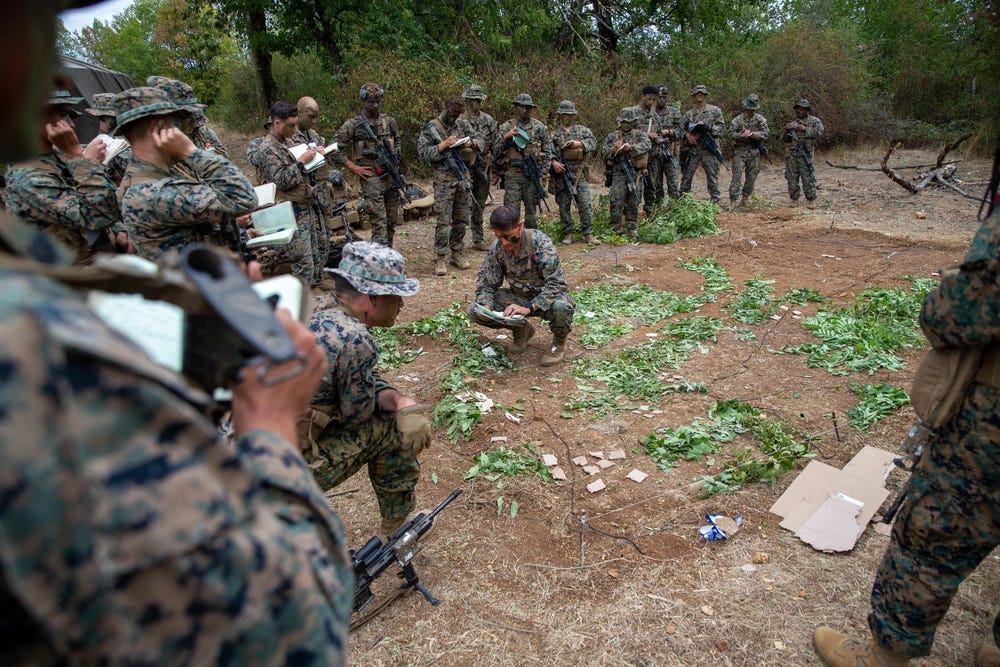
“Excuse me, Captain Russell? Where should I look to find an example of a good convoy order? What manual do you recommend?”
Marine Corps infantry manuals are terrible at explaining orders. Each of the following manuals describes a unit—its organization, equipment, and capabilities— but then never explains how to operate the unit, how to direct it:
MCRP 3-10A.1 Infantry Battalion Operations, 31 July 2020.
MCRP 3-10A.2 Infantry Company Operations, 4 April 2018.
MCIP 3-10A.3i Marine Infantry Platoon, 10 June 2019.
MCRP 3-10A.4 Marine Rifle Squad, 7 August 2020.
NONE includes an example of an order. NONE includes a single sentence of an example.
NONE specifies who does what and when to produce an order.
NONE explains parallel planning and the orders process between echelons. NONE discusses orders for different types of operations or different environments. NONE includes a correct orders template. The templates provided are filled with errors.
And yet in combat, Marine leaders issue orders every day. What are their techniques? Where are these techniques explained? Where are they taught?
MCRP 3-10A.1 Infantry Battalion Operations contains absolutely NO guidance on orders, no discussion of the orders process or products, and nothing on the roles of the commander and S-3 in producing battalion orders. The manual dodges all responsibility by simply pointing to the MCWP 5-10 Marine Corps Planning Process, 4 April 2018.
MCRP 3-10A.2 Infantry Company Operations is worse. The company commander is a key leader on the battlefield—directing and controlling complex tactical evolutions with attached weapons, air support, and indirect fires—yet this manual provides almost nothing of value on the critical skill of how to construct and issue a company order.
Instead, the manual is infected throughout with operational-level terms and Marine Corps Planning Process concepts that have NO place in the infantry company. The manual recommends that OPTs conduct an unexplained “abbreviated version” of MCPP, generating useless LOEs, MOPs, MOEs, COGs, COAs, and decision support templates. Companies are told to produce battalion-level lPB products. Eight pages discuss operational design.
But the Marine Corps Planning Process does not apply at the company level. Multiple sentences discuss the distribution of the order “and associated products,” implying that a published order with appendices is expected from the company. This is wholly unrealistic. Although rehearsals are recommended, and ROC (rehearsal of concept) and CAR (combined arms rehearsal) are both mentioned, there is no explanation and no recommended procedure for how best to conduct a rehearsal. A terrain model is mentioned once, with NO explanation.
Appendix D lists tactical tasks, but there is NO appendix with a company orders format, and NO example of a completed company order. If, as the manual states, “The company commander determines the format” of the order (page 2-10), why have a doctrinal manual at all?
MCIP 3-10A.3i Marine Infantry Platoon provides three entire pages on the platoon order. Unfortunately, there are NO examples, and no specifics on orders for the offensive and defensive tasks of the platoon. There is one odd mention of a “linkup annex” on page 212, but platoon orders are “normally issued verbally” (page 57). Annex J includes an orders format. Warning orders, terrain models, and rehearsals are all mentioned throughout the manual, but there is little instruction on how to execute these critical procedures.
MCIP 3-10A.4 Marine Rifle Squad also provides almost NO guidance on orders. In describing the troop leading steps, “issue the order” is directed but not explained. What does the squad leader actually do? What does a squad order look like? This omission is particularly bad given that the manual is intended for a wider audience—both infantry small unit leaders and “units serving as provisional infantry.” Our junior leaders, often with the least experience and training, should be getting the most guidance and the clearest examples of how to issue an order in combat.
In the recommended orders template, Figure C-4, fully half the entries are wrong, do not belong, and should NEVER be included in a squad order—a platoon order—or a company order.
Squad orders do NOT have references. Squads do NOT have combat service (CS) units.
Squad orders do NOT have annexes. Squad orders do NOT have distribution lists. Squad orders are NOT classified. A squad leader is NOT a commanding officer. Squad orders do NOT have an official signature, signed on behalf of the commander.
Squad orders do NOT have time zones. During World War II, when paper copies of orders were distributed by runner, a log book tracked who received copy 1 of 12 copies. When a unit received an order, they were required to acknowledge receipt by transmitting the six-digit message reference code over an uncovered radio net. Squads never did this. NONE of this is relevant today. ALL of it is wrong. Why is it in our manuals?
Army infantry manuals—ATP 3-21.20 Infantry Battalion (2017), ATP 3-21.10 Infantry Rifle Company (2018), and ATP 3-21.8 Infantry Platoon and Squad (2016)—are much better than Marine manuals at explaining orders. These manuals are specific—who does what—and prescriptive. Battalions—with staffs— plan, while companies, platoons, and squads execute. The battalion publishes an operation order with appendices, while company-level leaders execute troop leading procedures, makes estimates, and generate concise verbal orders. The company manual clearly specifies the troop leading procedures, the orders format, best practices for conducting rehearsals, and checklists for PCCs and PCIs.
The best Marine Corps manual for company-level orders is actually the long- outdated, MCRP 3-30.7 Commander’s Tactical Handbook, reprinted in 2018. This publication emphasizes the importance of orders and recommends orders techniques for multiple different types of combat operations. The orders template (page 5) is outdated, but still usable.
How do we fight? How do Marine leaders direct units in combat? How do we communicate—issue and receive—clear, concise, and critical orders under pressure? These are important skills for any military organization. The Marine Corps needs better doctrine on orders.
This article is extracted from the new Orders: A User’s Guide which will soon be available on www.2ndbn5thmar.com. Want to contribute to Orders: A User’s Guide? Contact LtCol McBreen at bbmcbreen@warfighting.us to offer your services.