
Saved Rounds 2.9.24
Articles, resources, and responses for your weekend coffee

Editor’s Note: Saved Rounds is a weekly post for the CxFile Staff to share articles, resources, and responses we’ve found to the wider audience.
Retrans - Responses from the Community
From a Spotify listener for Episode 1:
Question: Awesome episode Sir! Our reserve company is squared away, but it seems like we only get to focus on 1-2 “things” every year (PB Ops, ITX, MOUT, etc). What should we push to train for in 2025?
Our Response: You already mentioned it, but it is worth starting with a hard look at what SLTEs are on your schedule. As an example, you can reach out to TTECG for their most recent training guidance. It is also worth establishing a relationship early with your HHQ and adjacent units. HHQ will likely have some initial guidance and your fellow training units could offer additional training opportunities for your team. If inter-operational or cross-training opportunities exist, go for it!
If you are starting from scratch and in the vein of the conversation with Col Cuomo, here are three things that will likely provide a big payoff:
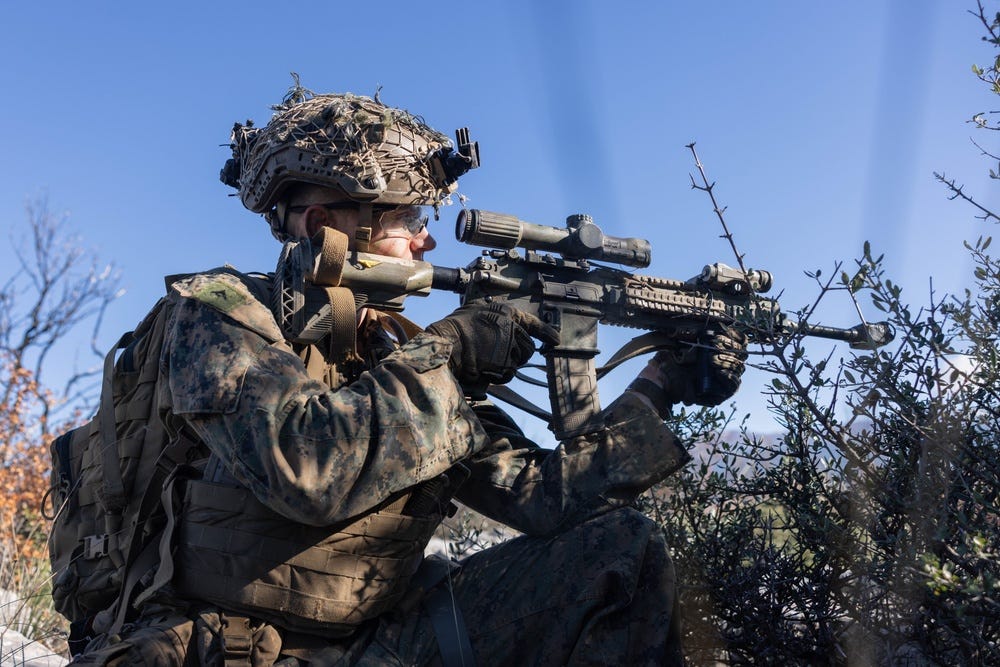
Scouting and Patrolling: The hallmark of truly capable infantry formations. This training requires nearly zero resources. No matter what we are doing: offense, defense, security operations, recon; these skills will make you successful. Patrolling also provides the opportunity to ruthlessly enforce fieldcraft and evaluate your small unit leaders. Can you: properly camouflage Marines and their gear? Follow a spoor trail? Accurately report? How is the squad’s posture, route selection, and actions on contact thirty minutes into a mission? How about three hours in? You can learn a lot about a Marine in how they prepare for, execute, and finish a tough patrol!
MOUT: If recent conflicts are any indicator, future battles will very likely be urban. It is a difficult environment to master that must be trained to early and often for future success. This is another training package that requires relatively few resources. Tape houses are cheap and quick to set up and most training areas offer structures to rehearse. You can even conduct terrain walks out in town to discuss setting conditions, phase-line battle drills, and exterior movement. MOUT is another great venue to evaluate leaders! How is the foothold fire team going to respond when they are cut off in a building with an unknown enemy situation, and the only friendlies are back across a contested street?
Combat Marksmanship: You need to hit what you aim at. This applies to all of the weapons in your arsenal (looking at you, rockets). Every unit could improve in this category. Find opportunities to ruthlessly train combat marksmanship every chance you get. Dry firing, range estimation, and fire commands require no resources at all and are keys to success.
Finally, mix in verbal orders, calling for fire, casualty care, and evacuation with the above training, while focusing on small-unit leader development!
To our readers, what did we miss? Send along your recommendations in an email or in the comments below!
Support Up!
A call for articles on Counseling and Coaching!
Feedback is the most important task of a leader. Whether it is the ping of steel or a FITREP counseling, Marines need to know where they stand and how to improve. We’re asking the CxFile audience for their best practices, tough lessons learned, and ideas for service-wide improvement. Please check out our submission guidance or contact us for assistance. Whether it is a half page or 10, we want to hear your thoughts for the good of those we serve.
The Bulletin Board
War on the Rocks - Automation Does Not Lead to Leaner Land Forces
Jack Watling of RUSI, and the author of The Arms of the Future, makes a cogent argument why automation will not reduce the size of squads and platoons. In fact, he argues, it will potentially increase the logistics tail for companies and battalions due to required operator and sustainment support. Automation, though highly valuable in many regards, is an unlikely solution for both our recruiting crisis and distributed operations.
Frontelligence Insight - On the Brink: Examining Ammo Shortages and the Overall Situation in Ukraine.
This excellent OSINT Substack produces detailed and evidence-based conflict analysis spanning all three levels of war. This week they published Part I of their assessment of the current state of the war in Ukraine. This read, and its soon-to-follow Part II, will catch you up on the status of the conflict and trends to watch throughout 2024.
Reminder! DMX solutions are due 21 February.
Last week we published our first Decision Making Exercise. Solutions should be sent to the community mailbox and the top answers will be published at the end of the month in Saved Rounds and in Notes.
Let your battle buddy know you are thinking about their lethality and send them this post.
Have an article or book you want to share with the community? Have a reaction or response to one of our posts? Send your traffic and we’ll serve as your retrans site.
Might I dare to suggest that the MOUT training might be supplemented with classroom sessions focusing on potential urban obstacles and hazards. Perhaps taking out a map of a local urban area and studying for potential hazards like the underground tanks of a gas station, chlorine tanks at the community swimming pool, radioactive isotopes stored at a local medical center or clinic, etc. how might you spot such hazards in the field, what added prep work might be desirable in the planning phase to cope with possible hazards?