From Shooter to Squad: Quantifying Collective Proficiency and Small Unit Leadership
By Sergeant Alex Reyes
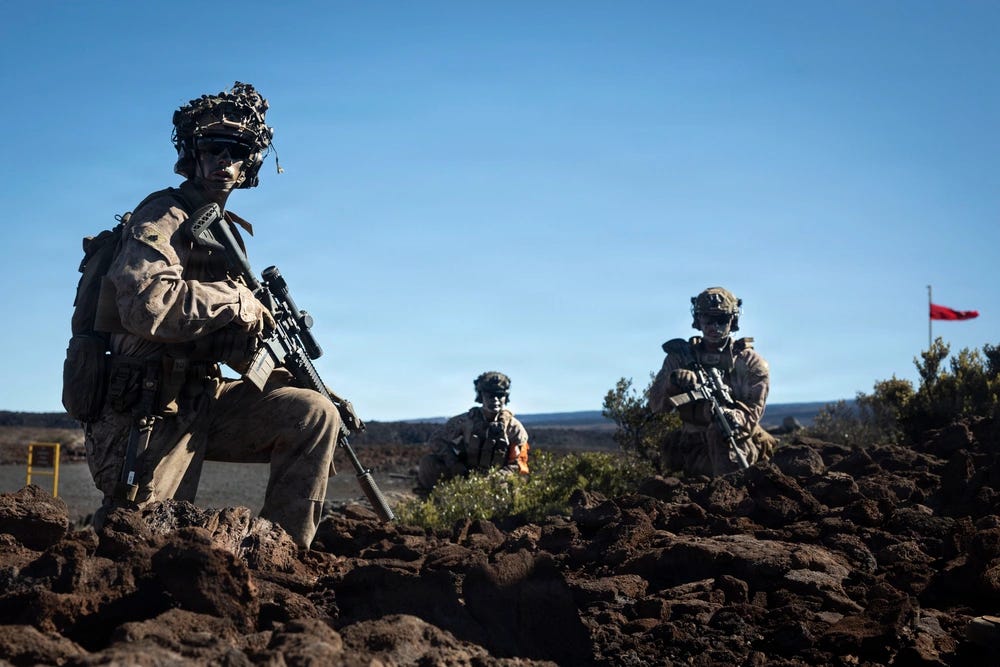
The Marine Corps has made strides in sharpening its approach to lethality. With the rollout of Infantry Marksmanship Assessment (IMA), the integration of Joint Marksmanship Assessment Program (JMAP), and digital scoring through Practiscore, we now have detailed metrics on how our Marines shoot, move, and react. However, there is a gap between these controlled evaluations and actual combat performance. While data suggests proficiency, mission readiness includes more than point-of-impact data.
IMA and JMAP are solid tools. They give us statistics, trend analysis, and heatmaps of performance. But no flat range prepares a squad to establish fire superiority, distribute fires, and maneuver effectively under the control of a squad leader during contact. High IMA scorers can still underperform when thrown into the dynamics of collective live-fire, not because of poor marksmanship, but because combat effectiveness depends on the control of fires, not just marksmanship.
We are leaving lethality on the table.
To forge a superior force, the Marine Corps infantry must shift from a culture of subjective opinion to one of objective evaluation. The path to achieving this transformation is scalable and achievable, but must begin at the lowest levels of leadership.



Using the Tools We Already Have
The IMA is a rigorous, combat-driven course of fire adopted by the U.S. Marine Corps to evaluate a shooter's actual lethality by demanding both speed and precision across dynamic, high-pressure engagements. To accurately evaluate this physical test, the military relies on the JMAP, a specialized digital data-collection and analytics ecosystem that records split-second shot times and target hits to generate comprehensive performance dashboards. The technological foundation for JMAP is heavily rooted in PractiScore, a widely used civilian software program for scoring practical shooting matches.
Putting the Data to Work: Improving Squad Live Fire Through JMAP
While current marksmanship assessments excel at evaluating the individual rifleman, we fail to employ a mechanism to capture data at the fire team and squad levels. By integrating Trackless Mobile Infantry Targets (TMITs) into unit training, we can finally bridge this gap, capturing quantitative data on how quickly small units can effectively engage targets. This collective data does more than just measure speed and accuracy; it serves as an objective evaluation of fire team and squad leaders’ abilities to effectively assign, direct, and control fires.
The key is not to build complex scenarios, but to run simple, repeatable lanes where the effects of fire direction and control can be observed and captured. Standardized drills allow evaluators to isolate variables and measure a leader’s ability to direct, shift, and control fires against measurable time and accuracy standards. Because data collection becomes more complex as shooter volume increases, evaluations must begin at the fire team level. Capturing this fire team data establishes a critical baseline of immediate-level leadership and lethality. Once this baseline is established, leaders can scale these drills to the squad level. This phased progression ensures evaluators can distinguish between a squad leader’s ability to control multiple elements and the literal and statistical noise of uncoordinated individual shooters.
Relevant to all lanes below, leaders should determine consistent TMIT settings for Hit Thresholds; Vital vs Non-Vital Zoning; and Variable Reactions. Consistency is key, as is determining the precise metrics one wishes to evaluate from their units and subordinate leaders. Some recommended data to assess across each lane:
Time between observation and engagement?
Time between engagement and suppression and/or destruction?
How much ammo was expended?
All of the above under limited visibility conditions.
Lane 1: Static Live Fire
In this scenario, the unit establishes a linear firing position, facing TMITS. The targets tactically represent an ambush, defensive position, or base of fire. Their resting heart rate serves as the variable to assess during execution.
On initiation, the unit leader provides a fire command, an Alert, Direction, Target Description, Range, Assignment, Control (ADDRAC) (unless issued previously), and assesses and directs fires as the situation dictates.
Observers assess effectiveness using the DRAW method: Distribution, Rate, Accuracy, and Weaponeering, as applicable. Targets either drop or they do not based on establish hit criteria. If they remain standing longer than expected, the issue is visible in fire distribution and control rather than guesswork.
Lane 2: Deliberate Attack
The unit conducts a deliberate attack on a target array. The unit must maneuver to its assault position, establish fire superiority, and assault through the objective.
The variables present are an elevated heart rate and judging both terrain and fires while dynamically closing with the enemy. Additionally, modern technology can be used to assess relative physiological performance by checking heart rate and exercise data following the completion of the event.
This lane judges both accuracy and control while incorporating dynamic decision making. Evaluators should look for correlations between unit leaders who need to explicitly control their Marines and those who can lead with implicit guidance.
Lane 3: React to Contact
In this scenario, a dynamic and moving unit maneuvers through a lane and receives contact from TMITS targets. The unit leader must then establish fire superiority and determine how best to maneuver based on the characteristics of the scenario.
The variables include elevated heart rate and the need to assess both terrain and fires without reconnaissance. This introduces more complex decisions, for both the individual rifleman and unit leader, allowing evaluators to assess the capabilities of their cognitive bandwidth.
Evaluation is based on how quickly targets drop once fires are properly distributed. Observers can then identify whether the issue lies in individual marksmanship while physically challenged and/or in the unit leader’s direction of fires.
Closing the Loop: Using Lane Performance to Drive Retraining
The true value of these lanes is how the data can help inform retraining in four areas: individual marksmanship, decision making, communication, and/or fire direction and control. Leaders can then compare lane observations with JMAP heat maps and IMA results to diagnose whether issues stem from individual deficiencies or leadership deficiencies.
Using previously collected IMA scores for each Marine, total up the unit’s collective lethality. This is their potential collective lethality. Now, compare that against their observed collective lethality from the training lanes. The final step is to determine what is enhancing or inhibiting performance. Is it leadership? Decision making? Physical fitness? Their combat mindset?
Remediation or progressive development now becomes precise. Instead of generic repetition, leaders can provide specific improvement plans for Marines based on measurable outcomes from the lane.
Over time, squads will see a direct connection between their marksmanship data and their effectiveness during live-fire collective training.
Conclusion
IMA, JMAP, and Practiscore give us a wealth of knowledge. By applying this data to how we run fire team and squad live-fire lanes, leaders can directly link individual marksmanship performance to collective effectiveness.
This approach requires no additional resources, only a shift in how we observe and evaluate what squads are already doing. When targets become the measure of fire and control, data becomes a tool for building better squads, not just better shooters.
Sergeant Alex Reyes serves as the operations chief for Fox Company, 2nd Battalion, 23rd Marines.