From Static OPs to Distributed Fires: A Company FST’s MEU Workup Lessons Learned
By Captain Vance Stiles
Opening Scenario
You are an FST (Fire Support Team) Leader, 0302 Infantry officer responsible for the planning and execution of your company’s fire support plan. Your company is still in the legacy infantry battalion structure and is in the middle of a complex raid training event.
A mixture of assault support and close air support aircraft is overhead, while your company and its supporting agencies are spread across 15km. Complicating matters is an evolving enemy situation.
You, as the FST Lead, are attempting to battle-track the rapidly changing position reports being passed over the company tactical net, deconflict the fires needed for elements in contact, and keep the rest of the company informed of what the aircraft overhead are seeing on the deck.
First platoon is tasked as your assault element. Unfortunately, the platoon commander’s radio goes down just before you have your Joint Tactical Attack Controller (JTAC) clear notional Hellfire missiles into the objective area. Due to a lack of comms, you are now uncertain of lead trace and cannot relay updates from Intelligence, Surveillance and Reconnaissance (ISR) aircraft to the platoon commander. His platoon sergeant gets on the company tactical net and starts requesting updates, but due to the complex nature of their assault, he is unable to manage close air support requests, ISR updates, and the evolving ground situation simultaneously.
With both the FST and Company HQ over 500 meters from First Platoon’s position, it is too late and too far to send a runner. First Platoon will have to take the fight themselves.
Defining the Problem
This was a scenario I found myself in at the beginning of my workup for a Marine Expeditionary Unit (MEU) deployment. The FST had just gotten attached to my company and incorporated into the Weapons Platoon, and we were quickly being thrown into the fire with a series of training packages focused on assigned MEU Mission Essential Tasks (METs), primarily raids.
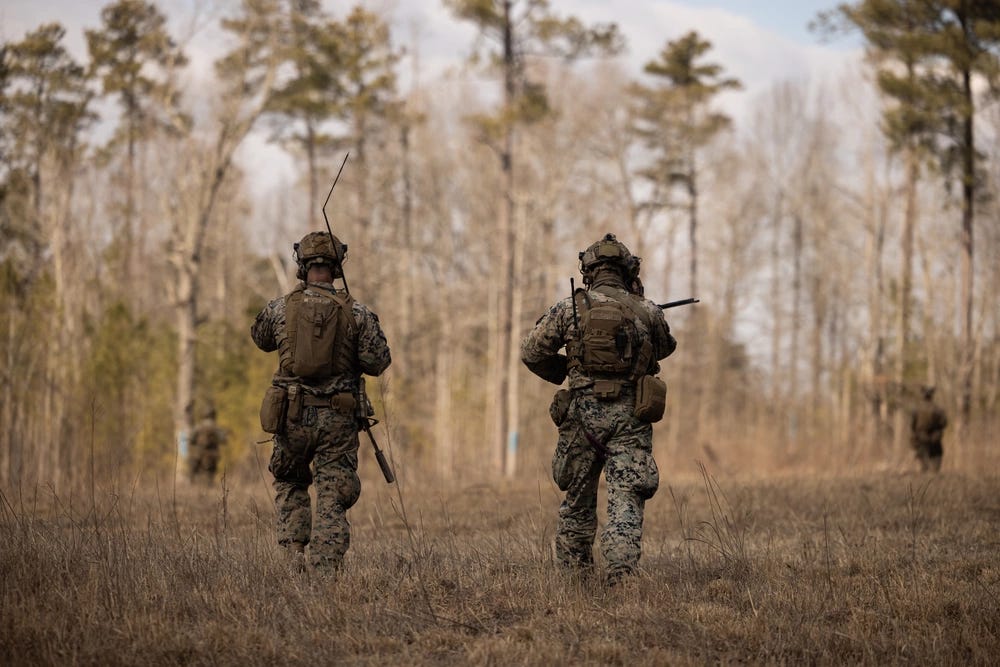
These events required the FST to adapt to decentralized, fast-paced operations. Traditionally, FSTs operate as a consolidated unit, placed at a static observation post. We quickly learned this approach wouldn’t work, as physical colocation did not provide adequate fire support, slowed operations, and reduced mission success.
We solved this problem by building a highly flexible FST capable of re-tasking for any mission, including attaching team members directly to rifle platoons. We accomplished this by properly equipping the fire supporters with the necessary equipment and training to improve their interoperability with the platoons. In this article, I will walk through the training events that forced the FST to evolve and then the T/O, equipment, and training adjustments we made to succeed.



Company Attacks (Seven Months Before Deployment)
For the MEU workup, we started with the FST team in its traditional setup as demonstrated at ITXs and FSCEXs: static, all together in a line, observing an impact area with a notional maneuver element. The FST, not formally chopped over to the company, had participated in several fire support coordination exercises with the company but had not conducted any live-fire attacks directly in support of the company.
Seven months out from our deployment, we completed our MCCRE (Marine Corps Combat Readiness Evaluation) live fire exercise, a company attack at Camp Lejeune’s G36 range. This was the precursor to our MEU workup, and really the first time we had a highly complex problem set to solve. For this range, we had one platoon 6km to our north conducting a platoon attack on a squad-size element, and the rest of the company attacking a platoon-size element that had limited technical vehicles. We also had an enemy indirect fire agency that needed to be neutralized. The company had the battalion 81mm mortar platoon in direct support, along with a Javelin team. (Ref Maj. Joe DiPaola’s article sUAS Platforms in Support of Company Attacks for this scenario).
During planning for this event, we realized that the problem set had three distinct elements:
An enemy squad to the north
An adjacent enemy IDF agency
And a platoon-sized objective that was the focus of the attack.
For our FST, we were tasked with both disrupting the enemy IDF agency and limiting the platoon-sized enemy element from affecting maneuver. This required us to split the FST, with one team using a PUMA (sUAS) to identify and disrupt the IDF agency, and a team dedicated to directing 60mm and 81mm fires in support of both the maneuver and support-by-fire elements.
To accomplish this, we built what we called the “split-FST.” The FSO (Fire Support Officer, 0802) with two Joint Fires Observers (JFOs) stayed in the assembly area with our CLIC (Company Level Intelligence Cell), which was the only PUMA operator in the company at that time. This team was responsible for identifying and prosecuting any enemy IDF agency, and for tasking and relaying any ISR injects from the PUMA.
The other team contained the FST Lead, another JFO, RO (radio operator), and the Company JTAC. This team moved with the company’s main body to the support by fire element and coordinated 81mm and 60mm mortar fire in support of the assault (coordinating fires on the objective and clearing deep targets while tracking maneuver)
Changes Made in T/O, Equipment, and Training
T/O
After this successful event, we realized that the split structure allowed us to use a mix of assets to observe and target threats, while showing the FST that we didn’t all need to be in one spot to support the company’s efforts during fires. We T/Oed the split FST into two elements, an Alpha and a Bravo element. The Alpha element consisted of the FST leader, JTAC, Arty FO, and Radio Operator. The Bravo element consisted of the Fire Support Officer, the JFO, and the 81s FO.
Equipment
The FST arrived at our company with PVS-14s, putting them at a huge disadvantage compared to the Infantrymen who had PVS-31s. The FST was slower in movement at night and had a harder time acquiring targets due to this equipment limitation. We only had a set number of PVS-31s in the company, so we moved PVS-31s from our mortarmen to the FST and had the 0341s use PVS-14s. The FST also CHOP’ed (Change of Operational Control) with no organic HF radio equipment from FSB. We were able to make up for this shortfall by using PRC-160s that were organic to the company, but this limited the comms the company HQ could run, as it had only two PRC-160s in its allotment.
Training
The exercise revealed the need for UAS operators in the FST, as we had to rely on the CLIC for PUMA operations. We sent one of our JFOs to attend TALSA’s PUMA course (a one-week course that was easy to send him to during training gaps). In addition, we sent one of our 60mm Squad Leaders to the SkyRaider operator course, further enhancing the UAS self-sustainability of the company’s Fire Support Assets. This shrunk the killchain from its original setup of UAS Operator->FO->FDC->Agency to FO->Agency for 60s, and FO->FDC->Agency for 81s and Arty.
Raids Packages (Six months before deployment)
Shortly after these company attacks, the FST team was officially CHOP’ed to the battalion landing team, and the battalion CHOP’ed under the 24 MEU. This opened up a plethora of assets for our company to work with, with a reinforced ACE (Air Combat Element) was in support of our operations (for CAS, several sections of Cobras and Huey’s along with Harriers) (for Assault Support, MV-22s and CH-53s) along with a small boat platoon attaching to our battalion, giving us the ability to choose between a plethora of insert platforms.
At this point, Expeditionary Operations Training Group (EOTG) took over our workup. The first training package is raids-focused, and we began with squad- and platoon-level events, culminating in a company-reinforced raid. Our company was reinforced with an attached Combined Anti-Armor Team and multiple specialized teams, including EOD, Signals Intelligence, Communications Strategy, and Counter/Human Intelligence. The objective was platoon-size.] The raids mirrored the opening scenario, with highly complex environments presenting unique skill sets. We were consistently on the move as an FST and never had the time or tactical situation to set up a traditional FST OP or a vehicle-based FST team, as seen with MEU Truck/Mech Companies. Therefore, we broke the team down and began assigning JFOs to individual platoons per event.
For squad-level events, the FST focused on basic FO and JFO skills, reviewed raid planning, and integrated with the rifle platoons. FST members participated in lane training alongside rifle platoons and squads to gain greater proficiency in MOUT and CQB tactics. This also let us swap FST members between platoons, determining which JFO worked best with each platoon. For example, our most senior JFO aligned well with our 2nd Platoon, as they were usually T/Oed as the assault force and had the most dynamic situations. Our best swimmer was paired with 1st platoon as they were usually on small boats. Our 3rd platoon usually had 60mm mortars, so the JFO who came from 81s was paired with that platoon to better support their calls for fire.
Changes Made in T/O, Equipment, and Training
T/O
FST members were now attached to or detached from platoons per mission as individual enablers. We began assigning the same JFOs to the same platoons to develop their relationships with that platoon's staff. This paid off, as the JFOs were able to anticipate the platoon's needs and speed up the individual platoon’s decision and targeting cycle. The JFOs still remained in general support of the company but were attached to those platoons per mission.
Equipment
To enable FST members to operate in this decentralized fashion, we needed to increase their ability to communicate on the move across multiple UHF and VHF nets. This required us to issue them Comm-enabled Peltor headsets, as they did not CHOP over with those, and to delineate specific comm suites for each JFO. The recent addition of the PRC-163, with its dual-band capabilities, was a force multiplier for the JFOs, allowing them to maintain awareness from ISR and CAS aircraft overhead and to communicate with other FST members simultaneously over TACP-Local.
Training
At this point, all FOs were JFOs. This was done by the efforts of the JTAC and FSO teams, who ensured each member completed the course and graduated through meticulous preparation. This enabled us to have the JFO T/O spread. Without this level of training, I am not sure this employment concept would work.
Evolved FSCEX: Three Months Before Deployment
After the Raids Package, the FST conducted another Battalion FSC Exercise. Here, we were able to refresh our core FST METS, as we had not been able to do those during the raid packages. Initially, we were concerned that our focus on Raids and TRAP missions would degrade our FST team's skill set in a traditional evaluation. We found the exact opposite to be true. Because our team had spent an inordinate amount of time working on basic infantry skills and then operating in complex environments that required implicit tasking and communication, we operated more quickly and with greater lethality than at prior FSC Exercises.
During this FSCEX, we tested what we called the “single observer construct.” Instead of setting up the FST in a position where almost every observer, the FSO, and JTAC could see the target area, we only exposed one observer at a time and relied on our lead JFO as the only observer. This kept our visible signature to a minimum and allowed us to do all other actions in defilade (comm, planning, etc). Implementation was slow, but once established, the construct proved tactically sound. I would recommend trying this for all FSTs who normally don’t, given the way most OPs are built at USMC Installations.
T/O
We reorganized the FST under the Alpha/Bravo construct as used in the MCCRE attack, with the Bravo element conducting the leader’s recon for the OP, and then the Alpha element following in trace.
Equipment
Comm suites stayed the same as before, with some flexes and additions to support the comm structure of a full BLT. We also moved with main packs to carry additional optics so each observer had a CLRF-IC, a PAS-28, and some sort of tablet and batteries, along with extra cammie netting and thermal blankets to ensure the hide site we occupied was fully concealed from both thermal and EO/IR detection.
Training
No additional training was done for this concept. However, without prior work on individual skills and disaggregated teamwork, this concept would not have worked.
Conclusion
There is no perfect way to employ Company Fire Support Teams. Given the myriad problem sets they face from standard company attacks to TRAP missions, the method of employment to ensure fires are in support of infantry formations will always need to change. What will remain standard is the need for fire supporters to work as closely as possible at the lowest level to ensure a maneuver unit’s success. We need to equip our fire supporters with the same gear as the infantry formations they support, and train them on the suite of systems now offered to units. With the proper T/O, equipment, and training, FST can offer increased lethality and full MAGTF integration for any Commander.
Captain Vance Stiles is currently an instructor at the Infantry Officer Course in Quantico, VA.