
Why Are We Stopping at REDs? The Case for Closing Under Suppression
First Lieutenant Hunter Keeley
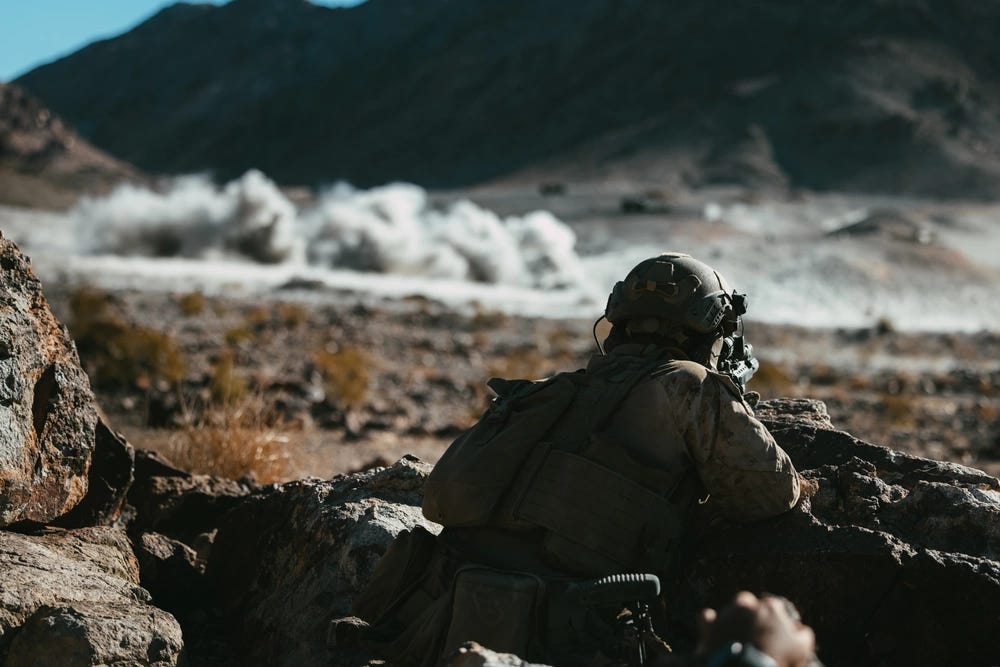
Combined arms, “the idea of presenting the enemy not merely with a problem, but a dilemma - a no-win situation,” is gospel to Marine Infantrymen. Ideally, the dilemma we present to the enemy is a series of effects that cascade from close air support, through artillery and mortars, before culminating in direct fire from machine guns and indirect fire from 40mm grenade rounds. Live-fire combined arms training is necessarily dangerous because a maneuver unit must close on the same ground targeted by supporting arms. To keep such exercises safe for units developing their fire control skills, we develop ranges with control measures that keep Marines away from impacts to avoid fratricide.
As a result, through both our training and instruction, we tend to create a dangerous expectation that it is possible to 1) observe the entirety of an enemy position, 2) suppress the entirety of this position, and 3) confirm the suppression of that position, which grants maneuver units the confidence to move over uncovered ground. Consequently, we develop training that disregards the lessons of history and the fog of war, while failing to distinguish between safety and realism. We restrict fires and maneuver under live-fire conditions for very good reasons, but we are missing critical training opportunities under simulated conditions. Therefore, we never really confront the challenge of combined arms - determining which fires are more dangerous, those from our own weapons, or those from the enemy. This evokes two questions we must confront. Are our ranges realistic? And, are we building the tactical judgment necessary to critically assess when our own fires become more dangerous than the enemy’s?
Undoubtedly, most commanders are pushing live-fire training to the edge of what is considered acceptable risk. However, I believe that establishing Risk Estimate Distances (REDs) as the rigid stopping point for fires in force-on-force training is excessively risk-averse and therefore fails to develop the tactical judgment necessary to determine how close forces can maneuver to the enemy before ceasing supporting agencies. To be successful in close combat, we must not only consider the proximity of forces to our own fires, but we must also consider the potential lethality of the enemy’s unsuppressed fires. This article outlines our current core beliefs regarding combined arms training and compares the procedures that have emerged from those beliefs against historical precedent. It then discusses current fire control methods and how they can be improved to ensure realistic training.



The Limits of Combined Arms Training
A combined arms attack is inherently more complex than a straightforward attack by fire because it requires coupling the movement of friendly maneuver elements with supporting fires, which pose a threat to the maneuvering riflemen closing on the very terrain targeted by those fires. To prevent fratricide from supporting arms, fire controllers must deconflict fires from maneuver either by time, lateral distance, or both. The Marine Corps trains its fire controllers to cease fires on the objective (deconfliction by time) or shift fires off an objective (lateral deconfliction) as the maneuver element approaches.
In training, the acceptable risk of fratricide is essentially zero, so fire controllers use Minimum Safe Distances (MSDs), the distance from a munition’s point of impact at which there is a one in a million chance of escapement, to determine when to cease fires. If you are standing the MSD away from the point of impact of a round, there is a one in a million chance of feeling any effects from that explosion. When an observer routes a fire mission to the Fire Support Coordination Center (FSCC), the FSCC charts the distance between the targeted grid and the nearest friendlies. If the nearest friendly unit is within the MSD, the fire mission will be disapproved; otherwise, provided there are no other concerns, the fire mission can be approved and prosecuted.
Occasionally, when the terrain and exercise control mitigate the risk to friendly forces from a round’s impact, units can obtain a waiver to shrink the MSDs to the Risk Estimate Distances (REDs) as a means of determining how far Marines can be from impacts. REDs is the distance from a munition’s point of impact at which there is a 0.1% chance of incapacitation. While riskier, this practice allows maneuvering Marines to close under suppression much nearer to the objective and to physically see and feel the same explosions they will be expected to run towards in a non-training scenario. MSDs and REDs have successfully enabled the Marine Corps to safely conduct live-fire combined arms attacks, but that does not mean they should dictate fire support decisions in force-on-force training or combat.
Author’s Note: REDs are controlled unclassified information (CUI), so we can’t publish them here. However, the JFIRE is available at ALSSA.mil. If you want a better sense of the distances referenced in this article, refer to pages 125 through 138 of the 2023 JFIRE for the most up-to-date REDs and MSDs.
Learning from History with an Eye Towards the Future
While MSDs or REDs are clearly the appropriate safety measures to prevent fratricide in live-fire training, a glance into the annals of modern warfare reveals an uncomfortable truth that is completely at odds with our current training: infantrymen in combat often close within REDs. The first modern combined arms, the creeping barrages of the Somme and Verdun, demanded artillery impacts within meters of friendly ranks. In 1944, at Pegasus Bridge in France, paratroopers brought naval gunfire onto the advancing Panzer Grenadier Regiment despite the poor targeting data available during D-Day. In Burma, the British’ penultimate handoff of fires was between 102mm HE rounds and 102mm penetration rounds, bringing infantrymen to within 10 meters of the enemy’s fortified positions.[1]Accounts from the Chosin Reservoir remind us that by-the-belt, overhead mortar fires are the norm in combat. David Hackworth’s assault on North Korean positions during that time kept impacts tight to the left and right of where he sought to penetrate enemy trenches.[2] In Vietnam, the 101st Airborne dropped over 1,000 tons of bombs in immediate proximity to friendly troops during a multi-day combined arms assault on Hamburger Hill. In Fallujah, Elliot Ackerman physically located himself alongside tanks, putting 120mm rounds into buildings just across the street. And now, in Ukraine, we see final protective fires tangential and even overlapping relevant foxholes.
Future combat engagements will not perfectly mirror those of the past 25 years, but it seems that the close-in fight is here to stay. In Afghanistan, approximately half of all engagements took place within 300 meters. The urban combat prominent during the Invasion of Iraq required room-to-room fighting, best measured in feet. Later on, the Battle of Mosul saw HIMARs and 155mm rounds impacting cater-corner from maneuver elements. Even in Ukraine’s open plains, where FPV drones that range 20km prowl, combat footage continues to show that tightly coupled suppression is required to close with well-dug-in enemy positions. There is no indication that close combat in urban environments is dissipating, and it is highly likely that units will continue to deepen and strengthen fortified positions in tree lines to avoid drones.
Most REDs are at or about 200 meters, the approximate point at which we can expect the enemy to begin engaging attacking forces with accurate direct fire. The riflemen closing in on an actual objective need as much suppression as we can provide them. History indicates that until they are nearly at a munitions ECR, maneuver units are more concerned about the risk from what is being suppressed than the risk from the suppression itself. Calculating the relative risks of incapacitation via fratricide versus enemy fire is impossible in real time, but it is logically clear that the risk of incapacitation from an unsuppressed machine gun bunker at REDs is just much higher than 0.1%. Therefore, ceasing supporting fires at REDs will actually endanger the maneuver force in most circumstances.
In training at the Infantry Officer Course and through the Fleet, we reinforce a belief that full suppression of an enemy position is not only achievable, but also can be confirmed in the heat of battle. Look at fighting in Gaza or read descriptions of jungle warfare in Burma - will you really know where all the fighting positions are before committing to assault fires? Ideally, yes, but realistically, unlikely. The record shows that veteran and blooded units will wait until the maneuver element is nearly within a round’s Effective Casualty Radius (ECR), not its REDs, before handing the battle to the riflemen. And this is to say nothing about the transparent battlefield currently being witnessed in Ukraine, which requires massing and closing at unprecedented speeds.
Recognizing that past, current, and future battlefields require supporting fires and maneuver elements to be more tightly integrated than the procedures we use to ‘safe’ our training will allow, we must make changes to our training in order to better reflect realistic combat conditions. I am not advocating for more permissive live-fire ranges. Rather, we should embrace current and emerging technology to simulate live-fire conditions and develop the tactical judgment necessary for small unit leaders to determine which fires they should fear more —those of their own or the enemy’s. Force-on-force training is the best opportunity to exercise such judgment; however, training standards are currently hindered by adherence to REDs, rather than a holistic evaluation of the situation. MAGTF-TC should closely review both the historical record and modern battlefield conditions to determine best practices to develop this sort of tactical judgment, incorporate these into their classroom and field training, and leverage MCTIS to teach, coach, and mentor exercise forces.
The Optimal Battlefield Handover of Fires
The moment at which a fire controller “hands the battle to the riflemen” and the squad leader “takes the fight” is the critical moment for fire controllers supporting a combined arms attack. Maneuver, which was previously moving under the cover of suppressing fires, must now support its own movement and is likely closer and more exposed to the enemy position than at any prior point. In the worst-case scenario, maneuver sprints within the REDs without realizing it, and is unprepared to independently support their final movement to the objective. The enemy, no longer suppressed, is able to freely engage the unsupported maneuver element. In the best-case, just as the final rounds from supporting agencies are hitting the deck, a battle handover of fires (BHOF) is conducted, and the maneuver element is simultaneously engaging with its own suite of weapon systems, using M32s, M320s, MAAWS, M67 Hand Grenades, and rifles to achieve overlapping and independent suppression of the objective.
Risk from Enemy Fires
In a combined-arms attack, the fire controller must balance the competing priorities of avoiding fratricide and effectively suppressing enemy positions. History, an enemy-first approach, and logic all suggest that, at REDs, the threat from the enemy is greater than the threat from fratricide within a well-trained force. If it were possible to determine, in real time, the risk of incapacitation from enemy fires in the same manner as we use REDs to calculate that of incapacitation from friendly fires, we could determine the precise moment that the fire controller should hand-off fires to maneuver: the exact point that the risk of incapacitation by fratricide exceeds the risk of incapacitation from unsuppressed enemy fire.
Unfortunately, the infinite complexities of a battlefield allow us only to make estimations. However, that should not deter us from developing the tactical judgment necessary to assess conditions in real-time and determine the proper balance of risk. In accordance with guidance from the ground force commander, the fire controller can and should make risk decisions to balance these theoretical prerogatives against the tactical situation in order to get maneuver onto the X.
Friendly Capabilities
The decision to cease fires should also be informed by the friendly maneuver element’s suite of weapons and its ability to engage at range with those weapons. In an ideal scenario, fire controllers do not cease fires until the maneuver element is in a position of advantage from which it can independently suppress the enemy position. Determining a maneuver element’s ability to suppress the enemy depends on its equipment and training. Such friendly capabilities should be considered alongside the risk of enemy fires and the risk of fratricide while making a decision to cease fires.
Consider the Marine infantry squad closing on a machine gun bunker. Eighty-one millimeter mortar impacts suppress the bunker, allowing the infantry squad to cross a field to a small hill where the squad will take the fight. The squad likely has a Multi-Role Anti-Armor Anti-Personnel Weapons System (MAAWS) team, an M32 gunner, several M320 gunners, and an abundance of hand grenades. The MAAWS has a max range of approximately 800 meters, depending on the DODIC loaded and the composition of the intended target. The 40mm round fired by the M32 and M320 technically has a max range of 320 meters. However, the advertised max effective range of a weapon system is distinct from the maximum range at which a Marine can skillfully affect the enemy with said weapon system. In the author’s anecdotal experience, MAAWS engagements outside of 300 meters are unlikely to achieve accurate effects unless handled by a particularly talented and well-trained gunner. To effectively engage the enemy, a Marine infantry squad likely needs to be within 300 meters of the objective and in the vicinity of micro-terrain, which will facilitate their continued closure. These factors should be considered in conjunction with MSDs or REDs when comprehensively assessing and managing risk.
Maneuvering Forward
In live-fire training, the MSD, or deviated MSD, is the appropriate distance at which to cease fires. In force-on-force training, REDs should be seen as a risk management tool for fire controllers, informing decisions to conduct the battlefield hand-off that are balanced against the enemy situation and friendly capabilities. Developing this judgment under simulated conditions is critical not only for closing with the enemy but also for reducing Marine casualties from both Red and Blue. To create a training environment where fire controllers and FSCCs are compelled to make more informed decisions about fires, beyond simply consulting the MSDs/REDs table, we must enhance our technical planning tools, refine existing call for fire (CFF) procedures, and promote the more robust use of existing technology.
Technical Planning Tools
REDs is the product of complex and classified analysis conducted at Air Land Sea Space Application Center (ALSSA). However, REDs themselves are CUI, so there is no reason why ALSSA couldn’t also disclose the distances, derived from the same calculations, from an impact at which the Pi is 0.5%, 1%, 5%, and 10%. While planning, the FSCCs could determine the acceptable risk in dynamic or extreme situations, and clear fires from correspondingly riskier distances commensurate with the ground situation. A more innovative solution would involve a new plug-in for the ATAK application, balancing the ALSSA risk estimates against the Digital Terrain Elevation Data (DTED) to quantify a terrain-specific range ring for an associated Pi risk.
Given the publication of more robust Pi data, units could determine a distinct Pi for each firing agency in planning that is reflective of the relative proficiency of each supporting agency. A rifle company supported by a junior 60mm Mortar Section with new leadership, an experienced 81mm Mortar Section with which they have already worked extensively, and a relatively untested Artillery Battery could use a 0.1%, 1%, and 0.5% Pi to determine the distance from impacts at which each respective agency is cease-fired. In this instance, junior and untested agencies retain the original REDs, while the relatively experienced and tested agencies are allowed to fire in closer proximity to friendlies.
CFF Procedures: Modified Danger Close of Final Protective Fires
Fires within “Danger Close” of friendly forces - 600 meters for surface-to-surface fires and 750 meters for naval gunfire - require the explicit approval of the ground force commander (GFC). To communicate to the FSCC and firing agency that the GFC has signed off on the fire mission, the observer will add the words “Danger Close” followed by the GFC’s initials to the third transmission of the call for fire. A second set of initials, possibly those of the mission commander (MC), could be provided to the FSCC and firing agencies to indicate command approval for fires that also fall within REDs. The MC’s initials could be acquired by the GFC in planning, based on a discussion between ground force and mission commanders regarding the potential need for ‘by the belt’ fires in execution. A distance in meters could follow the MC’s initials, referencing the preapproved distance at which the mission commander determines that the increased risk remains acceptable. The preapproved distance moves the ‘line in the sand’ that the FSCC uses to approve fires from REDs to a closer, more tactically sound distance. In this case, the transmission “Danger Close SMR[3], REDs PCH[4] 100” communicates that the mission commander approves fires to be as close as 100 meters to friendly forces.
Transmission 1 (Standard): “Deathrow, this is Joker FST, adjust fire, over.”
Transmission 2 (Standard): “11S MS 1234 5678, over.”
Transmission 3 (Modified): “[…], Danger Close SMR, REDs PCH 100.”
Alternatively, to approve fires within REDs, we can turn to the final protective fire (FPF) procedures. In a static defense, FPFs can be planned to impact as close to friendly positions as the effective casualty radius of the protecting munition. For instance, 81mm Mortar FPFs can be planned as close to 35 meters within friendly positions. To do so, Fire Support Teams ‘walk-in’ impacts from afar, making marginal corrections closer and closer to the friendly position. The risk mitigating factors that allow for this to be done safely are the dug-in and covered posture of friendly forces and the relatively static nature of the process. In dynamic situations in which the observer desires fires within REDs of friendly forces, the observer could ‘walk-in’ fires in the same manner as they would in an FPF. The modification to the standard fire mission would again be found in the third transmission. A comment to advise the FSCC and firing agency of the impending ‘walk-in’ and the distance/direction to the desired target from the passed grid would suffice to set expectations with the firing agency and the FSCC regarding anticipated corrections and utilize an already accepted technique that mitigates the risk of fratricide in new circumstances. An example of this type of fire mission follows.
Transmission 1 (Standard): “Deathrow, this is Joker FST, adjust fire, over.”
Transmission 2 (Standard): “11S MS 1234 5678, over.”
Transmission 3 (Modified): “[…], Danger Close SMR, requesting walk-in, 100 meters South, over.”
Training: Leveraging Modern and Emerging Technology
Existing ITESS/MCTIS laser tag gear could be used in force-on-force training to reveal to fire observers the relative risks of fratricide and enemy fire. Particularly with Pi data that covers the interval between REDs and ECRs uploaded into the system, observers would be able to balance the risk of fratricide against the risk of lost suppression, and the maneuver element will experience the simulated effects of both.
Fire controllers are not the only training audience whose judgment regarding the risks of fratricide versus that of enemy fires can be developed using ITESS gear. Similarly, rigid procedures are used to ‘safe’ direct fire weapons supporting combined arms assaults, just as their indirect fire counterparts are. The eponymous’ ‘15 degrees or 100 meters’ rule laterally deconflicts machinegun impacts from maneuver elements, but, like REDs, will unlikely be the appropriate point to cut fires when the enemy is shooting back. The first time a Machine Gun Section Leader decides to disregard the 15 degree offset in order to give maneuver another burst of suppression, it need not be in combat, nor need it endanger the maneuvering unit. ITESS can paint this decision point alive.
The ITESS/MCTIS after-action report (AAR) tool provides fire supporters with a visual recreation of the attack (or defense, or movement to contact, or infiltration). Fires observers, firing agencies, the FSCC, and, critically, riflemen can retrospectively check their individual recollections against the timestamped geo-locations of red and blue forces throughout. With the addition of ALSSA data to the timestamped geolocations, the visual depiction of the blue and red forces is enhanced by an understanding of the approximate risks associated with and faced by each element on the battlefield at any given time. AARs of this depth will demonstrate the degrees of uncertainty and risks that the maneuver element and fire observers navigate during an attack and enable thorough discussion of counterfactual courses of action and meaningful reflection on fires-related risk decisions.
Another technological innovation that could prepare units and Marines to more tightly couple maneuver with fires is augmented or virtual reality (AR/VR). One benefit of Range 410A and Range 400 in 29 Palms is that they give riflemen the actual experience of running towards live impacts, which elsewhere are commonly notional or offset. AR/VR could demonstrate, visually and audibly, various impacts, familiarizing riflemen with the phenomenon of closing with friendly fires. A follow-on benefit of AR/VR demonstrations of friendly impacts is that they allow those in the maneuver element to associate the visual and audible experiences of impacts at various distances with their respective risks of fratricide, thereby improving maneuver’s ability to make informed decisions based on friendly impacts.
Conversely, supporting arms can execute live-fire missions with simulated maneuver elements encroaching upon the ECR. By leveraging autonomous or unmanned platforms, such as MARATHON targets, to represent Blue and AR/VR, or other simulations, to represent Red, observers and firing agencies can conduct more realistic rehearsals themselves. AARs can utilize both sensor data and the actual inspection of unmanned platforms for shrapnel to provide user feedback.
The PSO in the Sky: FPV Drones
Conspicuously absent from most Marine Corps exercises, both live-fire and force-on-force, is the presence of FPV drones. Despite reports indicating that 70% of casualties in Ukraine are now caused by unmanned aerial systems (UAS), widespread adaptation and integration of weaponized UAS in the Marine Corps is ongoing. Some units have fielded the SB600 Switchblade, while others use the SkyRaider Payload and Marking Attachment (SPAM-A) with tennis balls to simulate munition dropper drones; however, progress is inconsistent. Notably, the adaptation of FPV drones is just beginning with the inauguration of the Marine Corps Attack Drone Team.
Drones are relevant to the discussion of fires, both for their potential retooling as munitions and for their ability to facilitate observation of the effects. A SkyDio or Puma in the overhead can reduce the uncertainty in an attack by tracking maneuver’s lead trace and by observing impacts. Whereas an observer in an observation post might lose track of maneuver or be able to only partially observe effects, a drone can improve the observer’s sight picture and reduce the risk of fratricide. Therefore, the employment of drones by fires observers should increase the commander’s risk tolerance.
Secondly, at some point, organic precision fires will become accessible to Marine Infantry. Comfort with tighter proximity between friendly forces and friendly impacts will be required to unlock the potential of FPV drones and loitering munitions. The inherent terminal guidance of OPF means the controller watches it collide with the target, which should decrease the risk that their impacts will result in fratricide if we allow drone operators to tightly integrate with maneuver in training.
Indeed, unlike mortars or artillery, FPVs are not area-fire weapons. They have great promise as the final supporting asset, suppressing an objective before a maneuver takes the fight in a combined arms attack. Their precision reduces the risk of fratricide, allowing the maneuvering unit to make several more bounds forward before establishing its own suppression. The principle that common-sense procedures, which prevent fratricide in live-fire training, should not exclusively dominate risk decisions in force-on-force training applies to the integration of FPV drones as much as it does to that of legacy fire support systems.
Conclusion
TECOM, specifically MAGTF-TC and TTECG, are in the best position to codify procedures and develop training to help both commanders and fire controllers refine the judgment needed to determine when to cease fires in close combat. By studying the historical record, utilizing scientific research agencies, and leveraging modern technology, we can cultivate best practices that ensure units understand how to effectively maximize their suppression without undue risk to their maneuvering forces. Through this process, we can truly develop the controlled aggression necessary to win in close combat, rather than inculcate habits we will be forced to break as soon as the fight begins.
In the meantime, commanders and their fire support agencies should re-examine their own fire control procedures through robust discussions, TDGs, war games, and terrain walks to best understand commander’s intent, risk acceptance, and implicit guidance. Creative training and novel procedures can overcome a lack of dedicated institutional support, and direct conversations with force-on-force observers and ITESS/MCTIS contractors can pave the way for simulated feedback.
Despite all the fanfare over the changing character of war, suppression remains the critical infantry task. To date, no technological advance has usurped this requirement. Neither F-35s nor FPVs, nor Abrams Tanks nor Tomahawk missiles have made obsolete the infantryman’s task of closing with an enemy position under that suppression. In a modern battlefield that is as cluttered, chaotic, and confusing as ever, it requires confidence nearly to the point of hubris to declare that an enemy’s position is entirely saturated with suppression. Therefore, Marines must remain acutely aware of the risk they face from both Red and Blue. If not, we risk failing on what we have always promised to do - ensuring the Lance Corporal can make it to the X and hopefully come home.
First Lieutenant Hunter Keeley is an infantry officer with 2d Battalion, Fourth Marines. He can be reached at hunter.keeley@usmc.mil.
[1] James Holland, “Burma ‘44: The Battle that Turned Britain’s War in the East,” BANTAM PRESS, 11 June 2024.
[2] David Hackworth, “About Face: The Odyssey of an American Warrior,” Touchstone, 15 April 1990.
[3] The “SMR” following “Danger Close” are the GFC’s initials.
[4] The “PCH” following “REDs” are the MC’s initials.



When I first saw the title, my reaction was less than enthusiastic. But upon reading the article, I was pleasantly surprised by how well your points are supported by historic/real-world context. I agree 100%. If live-fire must be tightly regulated for safety, force-on-force becomes the only avenue for maneuver elements to explore tactically sound, innovative methods to deal with the problems of real combat, and they can’t do that if they’re shackled by restrictions that real combat has required infantrymen to set aside in every instance of sustained combat against fortified positions since WWI.
In addition to your points, one that is also evident in the study of the examples you presented, as well as a study of the special action reports of Marines against fortified positions in WWII, is that our dogmatic concept of a tightly coupled, highly choreographed sequence of events, echeloning fires in a linear fashion from largest asset to smallest, is out of touch with the reality of engaging enemy in fortified positions. Something highlighted in the special action report from the 1stMarDiv on Okinawa was that the Marines had to use not only combined arms, but a different sequence of combined arms for every fortification they encountered.
The variables of real combat taught them very quickly that there was not a “one size fits all” sequence of events that could be applied to every position. In fact, the extreme opposite was true. It was up to the small unit leaders to find the right sequence with the right weapon systems to crack the particular fortified position they were fighting against on a particular day, and they had to figure it out by trial and error. The variables surrounding the next fortification made obsolete whatever sequence had worked on the last one.
I think your other point about the false confidence we breed in our Marines concerning what will be left on the objective after the larger DODOCs have been applied is excellent. It took 2/7 multiple days to clear a single fortified ridge on Okinawa which was roughly the same size as R400. They were supported with Naval Gunfire, tanks, and CAS, plus all their organic weapons and artillery. That completely contradicts what we tell Lts at TBS and IOC about the effectiveness of properly sequenced fires. They help us get within grenade range, but we’ll still have to fight for our lives when we get there, even with the most well-orchestrated “symphony of destruction.”
I've heard multiple O4s and O5s speak to why we need to understand MSDs/REDs aren't real when it's real, but this is the best argument for HOW we can demonstrate that, and allow the CMDR to own some risk. The author's exception point about obtaining the Pi at .5, .10, etc. from ALSSA, and incorporating it with the outstanding feedback available from MCTIS shows a greater understanding than just about anyone I've seen attempt to work this topic. The two variables would be allowing MCTIS (which is sitting in EXCON during MWX, on the other side of the Power I from the TTECG rep) to notify an OC/OR that on station with the unit closing, whatever effects they would have incurred, and of course the conversations that would invariably occur between risk-adverse CMDRs worried they are "building bad habits" and the on deck SULs trying to seize and OBJ from a defiant enemy.
Regardless, great work, great article, and great courage putting yourself out there with an unpopular opinion. Better to die than be a coward, and clearly this author is not a coward. Final thought: if your taking the risk of closing inside REDs, where are you during this? If the answer isn't up front...