Parting Thoughts from Company Command
By Captain Michael Downing
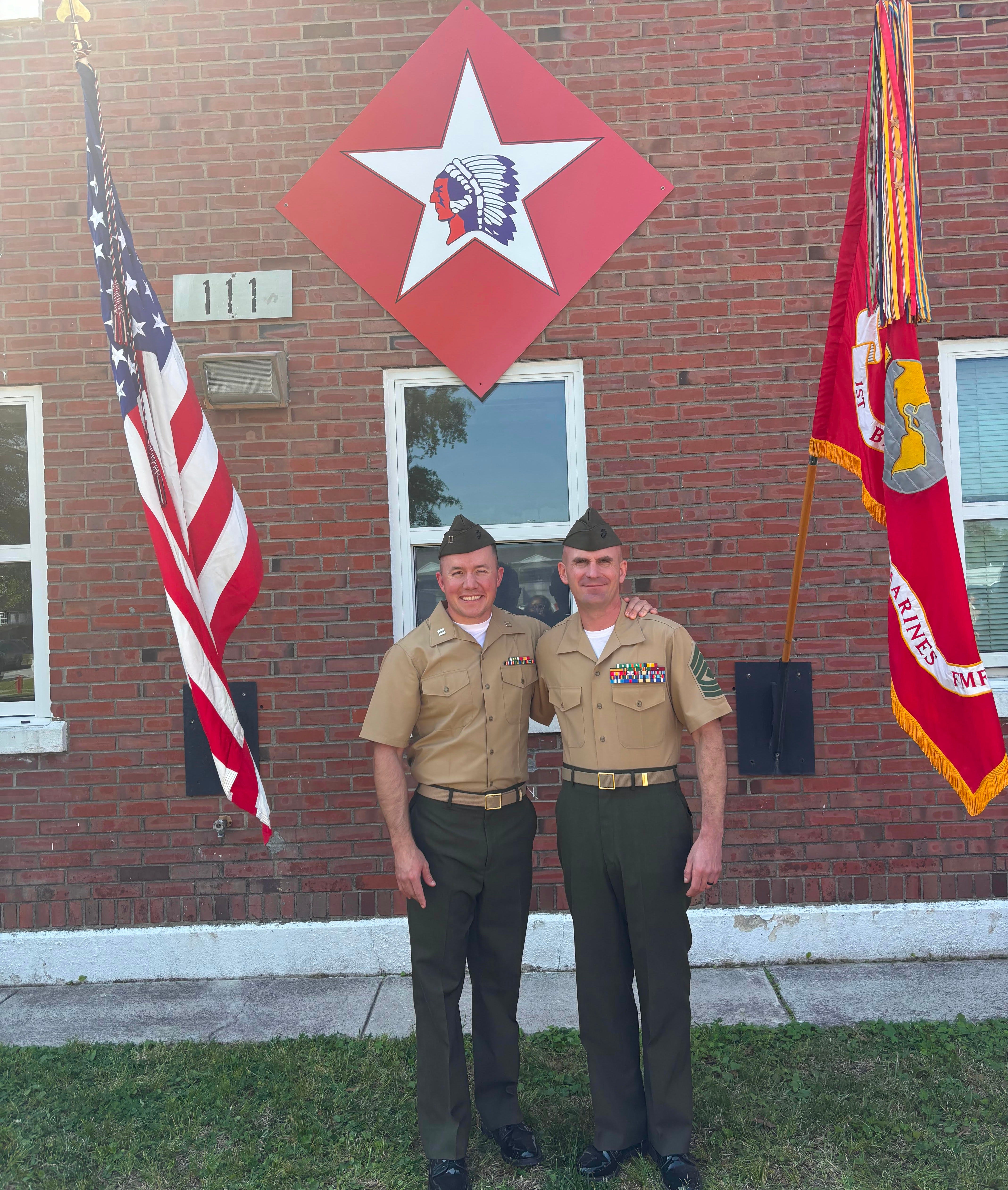
Having just finished my time as company commander for Charlie Company, V16, I put together some thoughts on the experience, following the example of Major Ryan Shannon with his article from 2023. I was in command for 23 months, during which time we participated in a combined winter Mountain Training Exercise / Integrated Training Exercise 400-series live fire. On our Unit Deployment Program rotation to Okinawa, we served as the III Marine Expeditionary Force Alert Contingency Marine Air-Ground Task Force Ground Combat Element first echelon company and did a six-week Korea Viper, which included a bilateral ski package with the Republic of Korea Marine Corps. I hope to share some lessons to help others who are currently in command or about to take the stick.
I wrote this with the help of my Senior Enlisted Leader, 1stSgt Mark Herbst, and that is the first lesson I want future company commanders to learn: even if you are not always physically together for all events, everything you do is with your First Sergeant. The more time you spend with each other, the more reflections you share with each other, and the more decisions you make together, the better he or she can understand your intent and the better you can harness their unique capabilities. Making this a guiding principle also helps you avoid micromanaging, if the decision isn’t something you’d discuss with your first sergeant, it probably isn’t worth you making. Give it back to whoever is asking and let them run with it. Here are my parting thoughts on company command as I reflect on my two years in the seat.



Influence Requires Persistent and Consistent Messaging
For guidance to the whole company, keep it specific and actionable, keep it brief, and say it as often as possible. If you want to see change across 170 young men and women, it takes time and effort to get your message to sink in. You have to be clear, concise, concrete, constant, and consistent. Our most obvious result with this was with the appearance of the company. 1stSgt systematically addressed cammies, haircuts, and mustaches until we had a company full of presentable Marines and Sailors. His message: get your appearance within the standards of the Marine Corps Order (clear and concise) by adhering to regulations and buying new cammies (concrete), and he said it the same way with the same reasons (consistent) at nearly every formation (constant) and demanded inspections at the platoon level to enforce the standard. Such work is easier said than done, but the command team that can focus on applying their message in this way can ensure success.
Common Understanding Matters More Than Any Product
Our doctrine communicates this message, but our habits don’t always reflect it. I am pleased that an outside observer would be hard-pressed to find the fine details of any company-level training or participation in battalion FEXs on our Teams page, but I can guarantee that the intent of the training and what we achieved could be readily recalled by our squad and platoon leaders. We made the deliberate decision to forego detailed PowerPoints or written training plans and instead used whiteboards to brief directly to all squad leaders and above prior to any field event, knowing that doing so reduced the amount of information we could communicate. There is a limit to how much someone can retain and communicate to their Marines. We did not want to equip every squad leader with a printed PowerPoint in an effort to force results in a field op. We found value in being able to look our leaders in the eye and ensure their understanding of the most crucial elements of our training, just as we would do before any operation.
The Company Staff, Communication, and Culture
The employment of the company staff is a deliberate choice, and the means of communication from the company to platoon-level leaders affect the culture of the company. The company commander is responsible for deciding how he will employ the members of their staff. If it is something that happens organically without inputs from the commander, then the staff’s operations (and, by extension, those of the company) will follow the inherent biases of the staff. We noticed that, while the company staff is called the “Big 4,” operating as a “Big 4” usually meant that we were stepping in each other’s lanes.
The company commander and first sergeant own all aspects of the company. The company commander should go to the first sergeant for everything, and while he can seek the feedback of his XO and operations chief, he should err on the side of tasking them rather than constantly seeking their input on decisions. This is not to say that the company commander shouldn’t go straight to the XO to talk about the armory or straight to the ops chief to talk tactics and training, but the point is that both of those billets have their lanes to cover, while the first sergeant covers everything with the company commander.
Additionally, as we recognized through all phases of our work-up and deployment, the way (location, size of the working area, separation from platoons, etc.) that the company staff was set up to operate affected the communication with the platoons. Any time we either deviated from the norm of our Lejeune office set-up, sync routine or altered the way the company staff was operating, we saw immediate and often disruptive results in the way our platoons operated. “Us vs. them” mindsets emerged with much higher frequency, often because platoon involvement in providing feedback for key decisions was limited. As the company commander, it is critical that you employ your company staff and communicate with your leaders with your desired endstate in mind. Don’t let the “situation dictate” how you are operating.
Develop Your Subordinates Through Shared Responsibility
Responsibility and leadership cannot be built among subordinate leaders if you don’t include them in the “adult” conversations about discipline and performance. Much of what is done to address Marines with performance or disciplinary issues (including alcohol abuse, problems with a spouse, financial problems, etc.) is done at the company and battalion level.
While there is a certain level of discretion that is necessary to maintain a Marine’s privacy, the result of this is that platoon commanders, platoon sergeants, and squad leaders can often be left in the dark about what is happening with their Marines. Resources like those presented during Force Preservation Council meetings or the discussions leading to punishments like NJPs and 6105s remain unseen by those leaders who interact with the Marine in question the most. If the battalion and company handling of those issues becomes a “black box” where platoon and squad leadership has no input or understanding of how outputs emerge, they are reduced to observing and reporting instead of caring for and leading their Marine. It is critical that you and your first sergeant close the loop with those leaders: provide them with as much information as possible about what happened at the company or battalion level, empower them with the resources and authority to enforce discipline and assist with issues, and keep them responsible for their Marine.
The Duty to Maintain Harmony Amongst Leaders
You and your first sergeant are responsible for managing the emotional relationships of your SNCOs and officers. Our leaders are screened and trained, but they are also human. Their emotional relationships with each other and to the company’s leadership play an enormous role in your ability to build and maintain trust. This is easier said than done, but at its foundation, this lesson is an extension of the classic marriage advice: “don’t go to bed angry.” Just as you and your first sergeant shouldn’t end a day without seeing eye-to-eye, you should not let emotional disagreements among your platoon-level leaders or between them and the company staff fester. Pull everyone in–whether that is 1stSgt with the SNCOs, the CO with the officers, or both groups together–and hear them out. Listen without defending, then provide your view and identify anything that you and your first sergeant will discuss and come to a later decision on. Letting off the emotional steam helps everyone to keep things professional. Having an “open door policy” isn’t enough. You have to be the one to initiate the feedback process when you can feel that things are off. We found that doing so for the issues we were seeing led to our SNCOs and officers bringing up issues that we were missing, presumably because they knew they would be listened to.
Being At the Point of Observation
Distant leadership leads to distant understanding, and vague supervision leads to vague outcomes. I take this one squarely on myself, and can apply it to a lot of things, but I’ll use PT as an example. I participated in one squad-level work out as a company commander and then, for the rest of my time in the seat, merely conducted my personal PTs around the battalion area so I could see my squads and platoons come and go as they exercised. I can remember every detail about that single PT I participated in, from the way the squad leader led to the workout we did, the way the team leaders acted, the fitness level of the individual Marines, and the ribbing and gripes about the MEU the battalion had recently returned from. I learned more about the readiness of that squad in one morning than I did in two years of seeing glimpses of all my squads from a distance. Did seeing that Marines were going out to PT give us better PFT scores or ensure that my intent for combat-oriented fitness was being met? Not at all. Instead, I lost an opportunity to endure hardship with my Marines, learn their strengths and weaknesses, and observe the performance of my squad and team leaders. Don’t think you’ll miss the forest for the trees by focusing your attention on a single small unit or individual event. It is the only way you can really understand how they are performing and the only way you will gain an understanding of the company as a whole.
Beyond Ductus Exemplo
Setting the example is not enough for junior Marines, SNCOs, or even officers to learn and maintain standards. It is only the foundation. Emerging from duty as a Marine Officer Instructor and OCS Platoon Commander, Ductus Exemplo was how I approached setting and maintaining standards within a unit. Eager young midshipmen and candidates emulate the officers who lead them. This is largely because they have no other established habits to come in conflict with whatever they are seeing. As a leader in the fleet, and particularly at the company level, you are working against the ingrained habits of multiple schools, potentially several years in the fleet, and the sheer size of your unit when you are trying to establish standards. I learned quickly that my own example of dressing, kitting, camouflaging, behaving, moving, and speaking was rarely enough to get even my lieutenants, much less any NCOs or junior Marines, to follow my behavior. The standard I wanted to see had to be explained and enforced time and time again before it started to stick. Fortunately, by setting standards prior to our SLTE and prior to taking on approximately 50% of our deploying strength, we were able to establish a baseline across the company that then carried over much more smoothly to those new Marines when they arrived. Standing with 1stSgt and setting the example together is still important. However, the most important key to setting and maintaining standards is ensuring understanding and supervision from leaders at the platoon and squad level.
Write What You Want, Enforce What You Write
Field and combat guidance is a checklist for leaders, not a guide for Marine success. My time away from the fleet made me forget how small the impact of written guidance within our organization remains. I published a one-page “field and combat guidance” for the company and talked with everyone in the company about it prior to a field op, yet I saw very little change in performance, even with platoon-level leaders. The lesson here was the same as all others related to standards. Explaining your expectation is only the beginning. Enforcing it is what matters most, even if that means an entire platoon re-occupies a defensive position or the entire company walks back out to a training area to pick up trash out of fighting holes. Those corrections and forced behaviors create the habits of action you want to see. Write your guidance, by all means, but make sure it is something that can be employed the same way any other tactical checklist can if you want to see it carried out.
NCO Leadership Development is Your Responsibility
NCOs know how to “Teach – Coach – Mentor” but you have to teach them how to lead. Boot camp, the School of Infantry, and our advanced schools do wonders for transforming civilians into Marines, basic Marines into infantrymen, and infantrymen into tactical decision-makers. However, I think they fall short in teaching leadership. By observing their instructors, NCOs learn how to be instructors, and that makes them very effective in performing many of their duties, including teaching, coaching, and mentoring. However, too often I observed NCOs “leading” PTs, training, or their units in the field with the same habits that I saw among instructor cadres. We have all seen these in the hoodie-clad corporal watching his Marines do drills in full kit, the heckling sergeant who won’t put himself under the log during PT, or the team leader who spends more time yelling “get that f***ing breach open” than seeing how he can help the PFC struggling with the grappling hook. Habits such as leading by example, sharing burdens with Marines, leading from the front, or bringing calm to chaos instead of adding more friction seem to not be taught (or are not sticking) to the Marines and NCOs in the fleet. You, your first sergeant, your ops chief, and your platoon-level leaders must intentionally model, teach, and supervise the use of effective leadership techniques among your NCOs. Aside from improving their ability to lead, this can also help your NCOs avoid behavior that can drift towards hazing and will keep them as proficient and fit as even their best junior Marines (if not more so).
Experience is Not a Substitute for Judgment
If you rely on experience to make decisions, you must rely on all aspects of that experience, and then make a new judgment call. One of the top three worst decisions I made as a company commander violated this lesson. One of my platoon commanders asked to use full kit ground fighting as part of a MOUT training package. I talked it over with him, with some of the other platoon commanders, with the MAI who would supervise it, and with a platoon sergeant, a former combat instructor. All of us had participated in full kit ground fighting during our MOS schools and/or had supervised it as an instructor, and while we knew there was risk involved with it, we thought that our mitigation measures (removing magazines and other objects from flaks, supervising each individual bout with a SNCO or officer, fighting on rubber mulch) were sufficient. We had also had a substantial ground fighting progression throughout the workup and deployment, so I felt comfortable with the exercise. An unconscious Marine who had been slammed into the ground a few bouts into our second iteration forced me to realize how wrong I was. While he fortunately walked away with no more than a concussion, I have been haunted by the possibilities of what could have happened. When I thought back–really thought back–to my time fighting in full kit at IOC, it was when we were utterly exhausted, it was all done from sitting positions, and it was between lieutenants who have already been forced to demonstrate self-awareness and self-control. “We did this at X school/unit” is not sufficient as a risk management process for ground fighting, live fire, or any other high-risk activity. You can use those experiences as a guide, but you need to think hard about what enabled the risks of that activity to be mitigated in that specific place and seriously question whether your unit and your training are meeting those same criteria.
Don’t Seek To Maximize Safety, Seek To Minimize Risk
In my opinion, one of the worst legacies of the COVID-19 Marine Corps is our eagerness to pile on safety measures to soothe the fears of our higher headquarters. During COVID, Marine policies frequently mandated “all the above” for a list of mitigation measures that civilian authorities recommended as “do one of these” options. In the fleet, it can quickly turn into every aspect of your range or training being an exercise in hand-holding just because you think your boss is a little nervous about a certain MAAWS shot or explosive breach. Working with your Gunner and any related SMEs (AirO for flight ops, engineer platoon commander for engineer missions, even your battalion surgeon for potential health concerns) to determine and mitigate risks and then having those individuals present to explain that process to your battalion commander goes much further to building trust and to building a better training product for the Marines than putting every possible mitigation measure into your JRAT.
Night Ops: A Choice, Not a Condition
Excellence in night operations does not happen without deliberate choices. We did one single “vampire night” in garrison, and did not do a single dedicated night of training in the field. That isn’t to say we didn’t train at night. One of our proudest moments as a company was our R400 night run, but we left so much on the table. If you want to build excellence in night operations, you have to shift your training paradigm to support this goal. If you train all day, you cannot train all night, at least not in a way that will be safe or effective. If I could do it all again, I would have used nights as our primary training periods and days as our secondary training and rest periods. There would have been a lot of friction, stumbles, and frustration, but I think it would have enabled us to focus solely on improving instead of also needing to overcome the human factors associated with training that comes at the end of a very long day. It would have built proficiency and confidence in the new optics (including the PAS-35 and ECOTI) that have come to the fleet in recent years that are technologically stunning but require significant amounts of practice to master. Night could have become our preferred area of dominance instead of merely being a condition we could work through.
Honesty Trace Your Priorities
If you are not in the seat yet or have been in command for any amount of time, I am sure you have plenty of thoughts about what you want your company to be. Some may be things you will implement soon after taking command: training guidance, initial counselings to key leaders, a hike progression, etc. However, just as no plan survives first contact, your bright ideas will crash headlong into the realities of the fleet, and many will not survive. The churn of a battalion workup will keep on churning, and it will not stop for you. If you have priorities you care about, you need to set aside time to deliberately assess whether you are implementing them effectively (or implementing them at all). I recommend after three or four months in command, and once more at the one year mark. Otherwise, you will find yourself heading off to SLTE, MCCRE, or deployment with things left undone. If you take the time to assess your priorities, at least you can determine what still needs doing or what can be left behind.
In Closing
This writing is not intended to create a dire and negative tone. I want to assure the reader that being a company commander is likely to be the most rewarding experience of their career, and that it will be an adventure unlike any other. These are lessons learned, not regrets–I would not trade my time with the Marines and Sailors of Charlie Company, 1st Battalion, 6th Marines (“Coldsteel”) for the world. They gave our company everything, and I will be eternally grateful and proud. Semper Fidelis.
Michael Downing exited the Marine Corps in June 2026 and is enrolled as an MBA candidate at the University of North Carolina, Chapel Hill. He remains eager to talk about his experiences and can be reached at msdowning01@gmail.com.