Securing The Beachhead: How Small Unit Leaders Can Innovate at the Water’s Edge
SSgt Joshua Mickles (USMC, ret.)
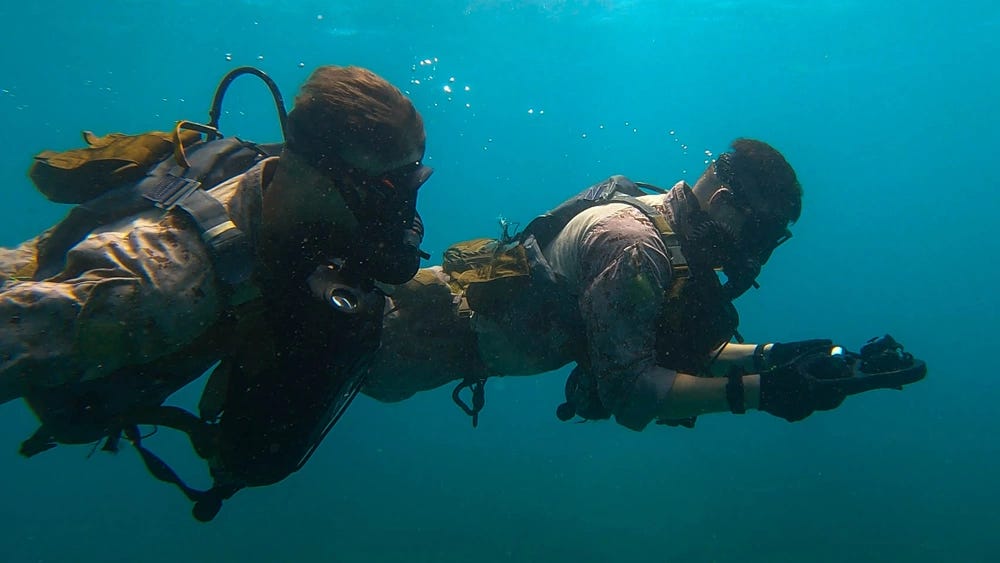
The littorals are not just a battlespace; they are a crucible. Shallow water. Shifting tides. Hidden obstacles. Enemy surveillance. Limited comms. For all littoral maneuver forces – from Naval Expeditionary units and Special Operations teams to Coast Guard and Army watercraft operators – this dynamic environment punishes hesitation and exposes capability gaps. Every decision made in the littorals carries significant weight, demanding speed, clarity, and real-time environmental awareness.
However, the tools we rely on across the force have not always kept pace with the complexities of this demanding domain.
Too often, critical decisions are still based on outdated charts, generalized weather forecasts, or infrequent manual surveys. We might task specialized units with dangerous reconnaissance missions or launch platforms into uncertain conditions due to a lack of better alternatives. While these legacy methods are built on the courage and skill of our personnel, they are not scalable and struggle to support the demands of distributed operations, where small, agile teams must operate autonomously and manage risk without constant higher echelon oversight.
Dominating the fight in the littorals requires more than just the tenacity of our personnel; it demands comprehensive environmental understanding. To achieve this, we need advanced technology, intelligent sensors, and unit culture that fosters frontline innovation and translates it into lasting institutional change.
A Smarter Way to Sense the Littoral Environment
Given the ever-shifting chaos of littoral operations, understanding the operational environment prior to engagement is paramount. From the initial deployment of forces to the final objective, success hinges on accurate and timely information about the sea state, surf zone, and subsurface conditions. While we currently leverage METOC units and forecast models to predict tides, currents, and surf conditions, these are just that—forecasts, not real-time observations. The most accurate assessments still rely on Marine Reconnaissance teams conducting hydrographic surveys, as outlined in FM 31-20-5. However, even these time-tested methods face limitations. By the time survey results are collected, analyzed, and communicated back to decision-makers, the data may no longer reflect current conditions. Today, advances in sensor technology provide a better way—offering real-time, automated data collection that delivers actionable intelligence exactly when and where it’s needed.
Traditionally, this kind of environmental data has been collected manually by specially trained units. In amphibious operations, Marine Reconnaissance teams conduct hydrographic surveys by physically entering the water to assess depth, surf conditions, obstacles, and bottom composition—often under cover of darkness and in contested zones. These missions are high-risk and time-sensitive, with results that require rapid transmission and interpretation. This method is labor-intensive and not always scalable for distributed operations across multiple landing sites. The emergence of real-time, unmanned sensor systems directly addresses this limitation by enabling broader, faster, and safer data collection without relying solely on manpower.
New sensor systems are now available that are small, fast, and easy to deploy without hindering maneuver. Their modular and scalable design allows them to support a wide range of operations, from large-scale amphibious assaults to small-unit insertions.
Consider Sofar’s Spotter Buoy, deployable from various platforms with minimal logistical burden or specialized training. Within minutes of deployment, it provides real-time data on wave height, swell direction, wind speed, and surface currents. This information empowers commanders to optimize approach lanes and allows amphibious planners to make informed decisions on launch timing, replacing guesswork with actionable intelligence shared across the force.
Complementing this hardware is Sofar’s WayFinder software, which integrates global forecast models with real-time buoy data to provide optimized maritime routing tailored to specific vessel characteristics. WayFinder enables units to plan safer and more efficient transits by accounting for changing ocean conditions, platform limitations, and mission priorities. Together, Spotter and WayFinder offer a powerful combination of sensing and decision support for operations across the maritime domain.
Closer to shore, the JaiaBot family of low-profile autonomous platforms offers a revolutionary approach to littoral sensing and beyond. These versatile micro-autonomous vehicles are small enough for hand-launch from rigid-hulled inflatable boats (RHIBs), combat rubber raiding craft (CRRCs), or even amphibious combat vehicles (ACVs). The JaiaBot can conduct rapid bathymetric surveys, detect complex current patterns, and generate detailed surf zone reports without exposing personnel to unnecessary risks. Due to its open-source software, the collected data can be viewed in any common operating picture, such as TAK and others, creating a seamless flow of information from the point of collection to decision makers.
Beyond hydrography, the JaiaBot’s compact design and endurance make it a versatile asset for littoral operations. This modular system can also be equipped with different sensor packages to support various activities. It also has the potential to be equipped with kinetic payloads for precision strikes, EO/IR sensors for persistent ISR, and environmental sensors to collect temperature, salinity, and acoustic data—building a comprehensive picture of the battlespace.
These capabilities, paired with high endurance and the ability to operate through surf, create a critical edge in maintaining situational awareness and projecting power.
Once ashore, systems like the Teledyne FLIR Black Hornet provide immediate ISR at the tactical level. Its portability, rapid deployment, and near-silent flight make it ideal for overwatch, route recon, and close-quarters situational awareness.
Combined with the Riegl LiDAR systems, these high-resolution survey tools can generate 3D models of beaches, ports, roads, bridges, and terrain. That kind of geospatial awareness enhances planning, obstacle avoidance, and mission rehearsal—all with the accuracy of current, local intelligence.
What makes these systems impactful is not just what they sense, but how seamlessly they fit into current operations. They do not require new command structures or special sustainment plans. They are built to support the way we already fight—light, fast, and decentralized.
These tools also help leaders manage the different risk tolerances of platforms like LCACs, LCUs, ACVs, or CRRCs. With real-time data, leaders can select the right beaches, adjust routes, and time insertions with far greater precision.
This is not about adding complexity. It is about eliminating guesswork. And these are just a few examples of affordable, scalable technologies available today.



From Promising Tech to Enduring Capability
The Department of Defense has increasingly prioritized rapid prototyping to shorten the timeline from idea to capability. Programs like the DoD’s Rapid Defense Experimentation Reserve (RDER), NavalX, and the Marine Corps Warfighting Lab’s (MCWL) S&T initiatives now exist to connect operators with innovators—whether they are traditional contractors, startups, or universities. These efforts accelerate design iterations, field testing, and real-world validation by aligning operational needs with emerging solutions.
Tools like JaiaBots, Spotter Buoys, and Black Hornets have benefited from this process—tested in exercises, validated through operational use, and adapted through direct user feedback. Rapid prototyping allows units to meet evolving threats and adapt their tools in real time, instead of waiting for traditional acquisition timelines.
But identifying effective tools is only the initial step. The more challenging aspect is transforming these tools into enduring capabilities that all littoral maneuver forces can reliably utilize at scale. This transition is often slow due to established acquisition processes designed for thorough validation and risk mitigation.
Currently, many units across different services are proactively fielding sensors like the Spotter Buoy, JaiaBot, and Black Hornet using operational funds. This initiative demonstrates leadership taking ownership of their challenges and finding practical solutions to mitigate risk. However, relying solely on these funding mechanisms is not a sustainable long-term strategy. Operational funds are intended for immediate needs, not for sustained capability development. Over-reliance risks creating unsupported, untrained, and ultimately unsustainable informal solutions.
This is where education becomes critical. Leaders at all levels must understand the process of transitioning promising technologies into formal Programs of Record. They need to know how to articulate capability gaps through well-defined requirements documents and advocate for these needs within the appropriate channels. This is not solely an acquisition issue; it is a fundamental leadership responsibility. Every commander should be empowered to connect frontline innovation with institutional change.
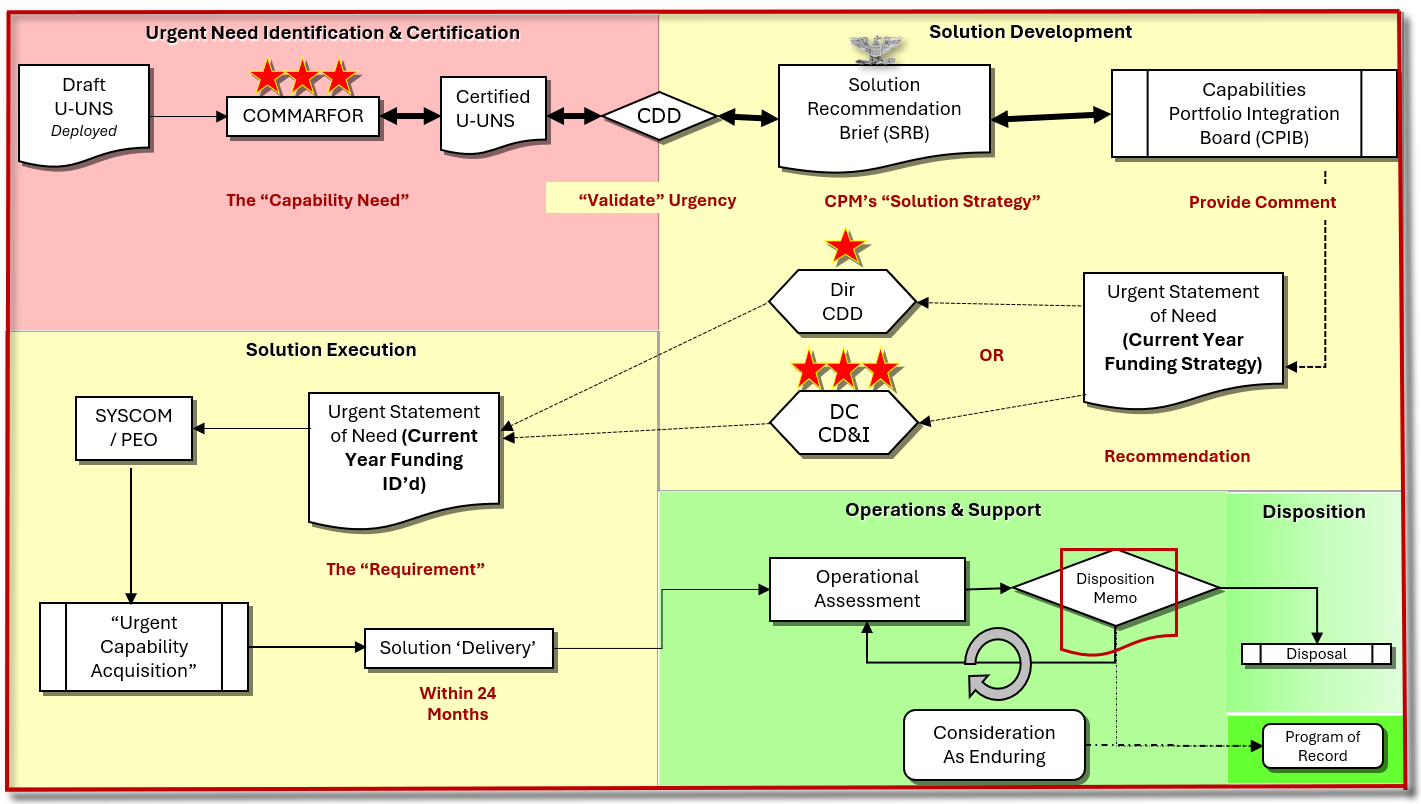
For junior leaders—especially lieutenants and captains—the path often begins with a Universal Need Statement (UNS) or Initial Capabilities Document (ICD). These documents define the operational gap, propose solutions and justify the urgency of the situation. From there, leaders should:
Capture and Document the Operational Gap: Clearly define the shortfall and explain the impact on mission success.
Test and Validate Solutions: Use training exercises or operational deployments to collect performance data and user feedback on emerging technologies.
Submit Feedback Through the S&T Enterprise or Your Command’s Requirements Officer: This could be via the Marine Corps Warfighting Lab (MCWL), your unit’s G-3/G-8 shop, or relevant experimentation events.
Engage with Your Service’s Combat Development or Acquisition Community: At the USMC level, this includes Combat Development and Integration (CD&I), which helps refine requirements and move them into formal planning.
Follow Through: Stay engaged. Follow the requirement as it moves through prioritization, resourcing, and validation.
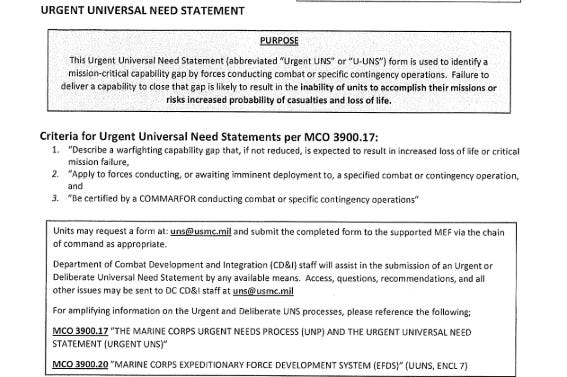
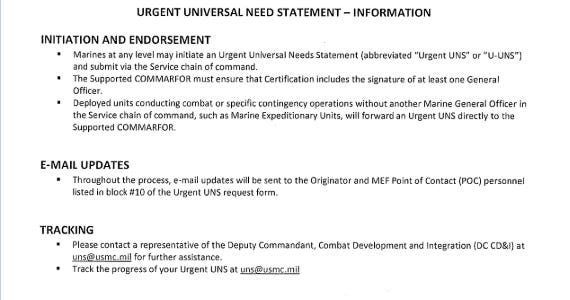
Understanding and participating in this process helps ensure that successful tools tested at the tactical level are not lost to time or turnover, but instead become enduring capabilities adopted across the force. Every commander should be empowered to connect frontline innovation with institutional change.
In the context of distributed operations, this connection is paramount. When small, autonomous units operate at the tactical edge, they must possess the tools necessary to accomplish their missions effectively. The institutional framework must be agile enough to scale successful innovations and sustain critical capabilities.
Our littoral maneuver forces have always demonstrated ingenuity at the tactical edge. The challenge lies in establishing a shared understanding of how to elevate these locally developed solutions into enduring, force-wide capabilities. A unit that procures a valuable capability with operational funds today might find that same tool unsupported in the future simply because it was never formally integrated into the acquisition and sustainment system. We are not at a loss for innovation, but we do have room to grow with our programmatic endurance.
This gap is not insurmountable, but closing it requires more than just individual initiative; it demands a concerted effort in education and process understanding. And it begins at the tactical level.
Building Smarter Leaders for a Modern Littoral Force
The complexity of modern littoral operations necessitates that commanders understand how to influence the systems that support them. This includes understanding how to articulate capability needs through formal documentation, how these needs translate into acquisition programs, and how to effectively advocate for solutions based on real operational gaps.
This is not merely administrative staff work; it is an integral aspect of modern warfighting.
As our forces become more distributed and operate with greater autonomy, we cannot solely rely on top-down solutions. The forward line of troops must be empowered to articulate its needs and pull the capabilities it requires. This begins with comprehensive education at all levels of professional military education, from initial entry training to senior service colleges. Future leaders should be taught how to navigate the acquisition process and translate innovative ideas into tangible capabilities.
How the Process Should Work: A Model for Success
Consider a scenario where a littoral maneuver element is tasked with a future mission requiring transit across a challenging surf zone with no updated environmental data. During initial planning, critical information is identified as outdated, and due to the unavailability of traditional reconnaissance assets, risk is present until this information requirement is satisfied.
Recognizing the inherent risks, the element leader proactively engages with a test and evaluation cell to rapidly procure and deploy a JaiaBot system using available operational funds. The autonomous platform is launched beyond the surf zone and immediately begins transmitting real-time data on bathymetry, wave height, and current velocity. With this precise information, the maneuver plan is adjusted, transit lanes are optimized, and the risks are significantly mitigated.
Following the operation, the unit leadership diligently documents the mission outcome, quantifies the impact of the new technology, and drafts a formal needs statement, submitting it through the appropriate service-level channels. This proactive step initiates the formal acquisition process, building momentum towards broader validation and potential integration across the force.
This scenario exemplifies how the system should function: frontline leaders identify critical operational gaps, explore and test innovative solutions, and then effectively advocate for their adoption within the institutional framework. The institution, in turn, listens, validates promising solutions, and allocates resources to develop enduring capabilities, ultimately strengthening the entire force.
The Bottom Line: Empowering the Littoral Maneuver Force
It is incumbent upon all Marine Corps leaders, at all echelons, to find solutions to the problems they face. Force Design is a challenging process and Marines must take ownership of the hard work required to reshape and refine the force. This begins with education and is sustained through force of personality and will. What follows are some steps that Marines can take to innovate, adapt, and overcome:
Educate Yourself and Your Team on the Requirements Process. Start by reviewing your service’s requirements generation process—within the Marine Corps, this begins with understanding Universal Need Statements (UNS), Initial Capabilities Documents (ICDs), and how they flow into the Joint Capabilities Integration and Development System (JCIDS). Leverage resources from Defense Acquisition University, the Marine Corps Warfighting Lab (MCWL), or CD&I’s Capabilities Development Directorate. Schedule PME sessions to walk your team through a sample requirement, or bring in your S&T rep (usually found at the MEF level) or requirements officer to discuss the actual submission process.
Integrate Emerging Tech into Training Exercises. If you're planning a field exercise, contact the Marine Corps Warfighting Lab, NavalX Tech Bridges, or your MEF S&T cell to explore tech insertion opportunities. Many companies—especially non-traditional defense startups—are willing to loan systems at no cost for experimentation if there’s a path to feedback. Reach out through your G-3, local Foreign Comparative Technology (FCT) rep, or directly to vendors you’ve identified. Ensure any use of emerging tech is built into your EXORD or CONOP and assign someone to document performance and operational value during the exercise.
Submit Observations Through Formal Channels. After the event, assign a team member to consolidate all data, photos, videos, and AAR content related to the new tech. Draft a capability shortfall based on that input and route it through your chain of command’s S&T rep or operational planner. Reference a validated T&R event or mission profile where the new system was impactful. If appropriate, submit to MCWL or NAVWAR’s Tech Scouting Teams. For added weight, submit lessons learned through the Joint Lessons Learned Info System (JLLIS) or to the Marine Corps Center for Lessons Learned (MCCLL).
Build Cross-Talk with Industry and Laboratories. Attend events like WEST, SOF Week, or Tech Expo to see what’s out there and ask tough questions. If travel is a barrier, join virtual NDIA panels, webinars from NavalX, or MCWL’s quarterly briefs. Don’t go alone—send your ops officer, comm chief, or recon lead and make it a requirement to return with a three-slide brief on what could solve current gaps. Use LinkedIn or GovCon portals to follow promising companies and track their progress.
Advocate for Force Design from the Bottom Up. Host internal innovation sessions, even if informal—invite your NCOs and junior officers to brainstorm force design changes based on their field experience. Start an innovation notebook or dashboard. Assign one rep per platoon to track workarounds and friction points and elevate them quarterly. Work with your XO or operations officer to pitch top ideas to your higher headquarters. Use your SITREPs or commander’s update briefs as a platform to communicate operational gaps that are not being met.
The future of littoral warfare will not be won solely by top-down innovation or new platforms delivered years from now. It will be won by leaders at every level who understand the operational environment, embrace emerging technologies, and fight to bridge the gap between field-driven solutions and institutional change. The tools to sense, decide, and act more effectively already exist—they are affordable, scalable, and ready to be employed. What we need now is a force-wide commitment to adopt them, a leadership culture that values initiative, and an acquisition process that listens when warfighters speak. Victory in the littorals will belong to those who prepare today—not just to fight, but to think, lead, and innovate at the edge.
(SSgt) Joshua Mickles (USMC, ret.) is a former Reconnaissance Marine and Basic Reconnaissance Course Instructor. He currently serves as a Vice President for Customer Success and Quality at Jaia Robotics. He can be reached at Joshua.Mickles@jaia.tech.