
Training Your Unit on Spectrum: A Company/Battery Commander's 30-Day Plan
A practical, no-nonsense guide to building electromagnetic spectrum competency with the equipment you already have.

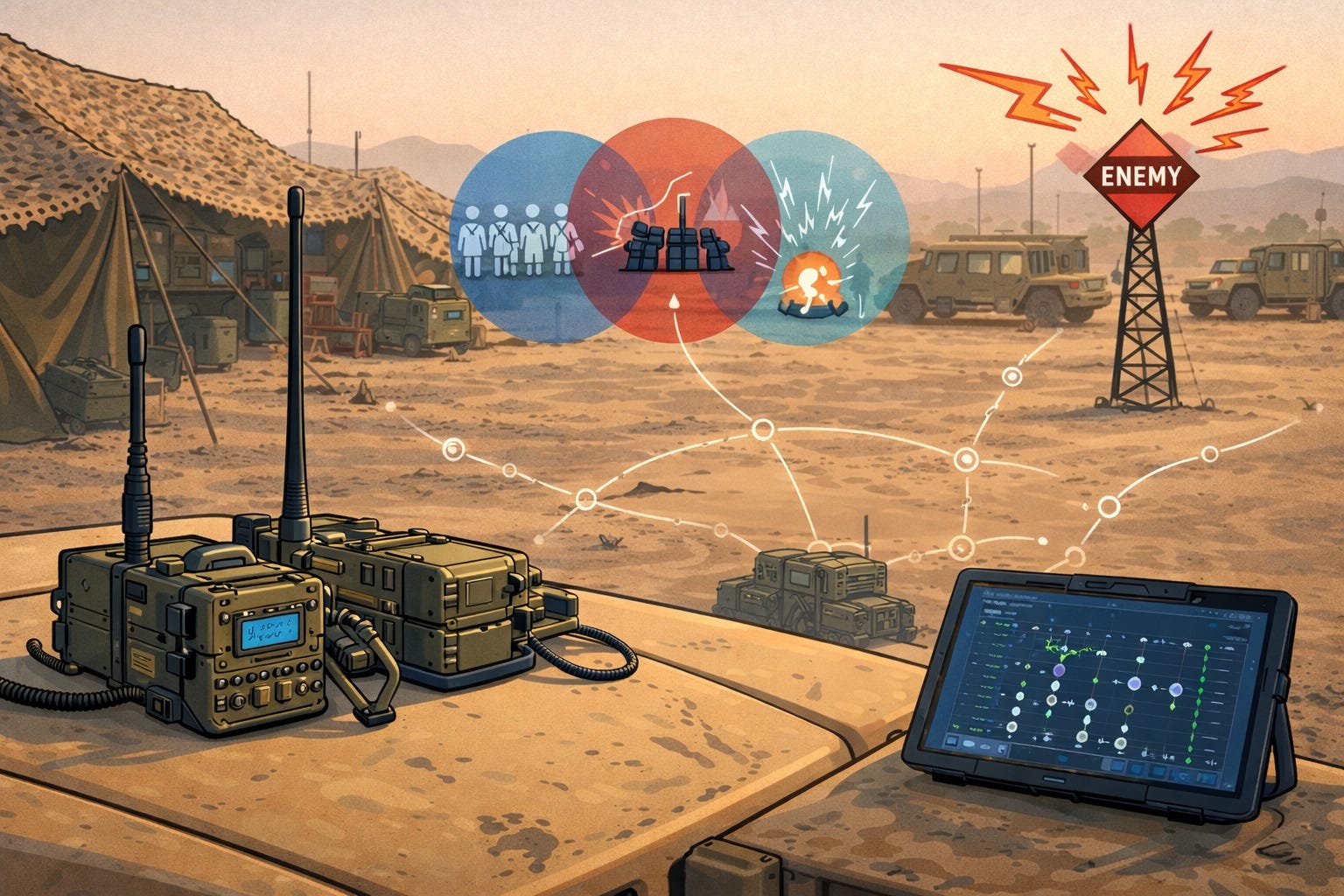
Editors’ Note: The CxFile has partnered with EMS 2025 to equip our readers with a practical understanding of the electromagnetic spectrum (EMS). On the modern battlefield, the infantry must understand spectrum management as fluently as we understand surface danger zones. To help bridge this gap, EMS 2025 translates complex technical concepts into relatable terms for those new to the domain. We strongly encourage you to subscribe to their Substack and take advantage of their excellent compendium of existing articles. Have specific questions you want answered by EMS 2025? Write to us and we’ll pass them along! Finally, this article was written by an Army officer, for an Army audience - not everything will translate perfectly to Marine Corps TO/E.

You’re a company/battery commander. Your S-6 just briefed you that the next rotation at NTC/JRTC/JRMC will include heavy electromagnetic warfare opposition. Your battalion commander wants all company/battery leaders to understand “spectrum operations.” And you’ve got 30 days before your next field problem to make it happen.
Here’s the problem: there’s no ATP for this. Your EW platoon (if you even have one) is undermanned. Your signal NCOs understand networks but not necessarily RF warfare. And your soldiers think “spectrum” is either something on cable TV or way above their paygrade.
This guide is designed to fix that. In 30 days, using only the equipment in your TOE and some creative training management, you can build a company/battery that understands the electromagnetic environment, recognizes threats, and employs basic spectrum tactics.
What this plan is NOT:
A substitute for formal EW training
Technical RF engineering coursework
Classified TTPs (everything here is unclass/releasable)
Dependent on specialized EW equipment you don’t have
What this plan IS:
A progressive crawl-walk-run training progression
Built around equipment you already have (ASIP, SINCGARS, cell phones, etc.)
Designed to fit within normal company/battery training time
Focused on practical tactical applications
Exportable to platoon leaders for their own training



The Training Philosophy: “See It, Shape It, Fight It”
This 30-day plan is built on three phases:
Week 1-2: SEE IT - Build awareness of the electromagnetic environment
Week 3: SHAPE IT - Learn to control and manipulate friendly spectrum use
Week 4: FIGHT IT - Apply offensive and defensive spectrum tactics
Each phase builds on the last. Don’t skip ahead.
Pre-Training Preparation (Before Day 1)
What You Need:
Radios: ASIP, SINCGARS, or whatever tactical radios are in your TOE
Smartphones: Soldiers’ personal phones (they are on them all the time anyways)
Tools/Apps (Free/Low-Cost):
Wi-Fi analyzer app (Android: “WiFi Analyzer” by farproc or Apple: “Fing-Network Scanner)
RF signal detector app (Android: “Cell Tower Locator” or Apple: RF Signal Detector)
Spectrum analyzer if your S-6 has one (nice to have, not required)
Training Area: Any location where you can conduct radio training (motor pool, range, training area)
Time Commitment: 2-3 hours per week, plus integration into normal training events
Coordination Requirements:
S-6/SIGO: Brief them on your plan, request any available spectrum tools
S-3: Integrate spectrum training into the training calendar
Battalion: Ensure you’re not violating any local spectrum management policies
Safety: Remind soldiers about RF safety (no transmitting near faces, established safe distances)
Leader Preparation:
Before you start training soldiers, you and your platoon leaders need a baseline. Spend 2-3 hours together covering:
Basic RF concepts (frequency, wavelength, power, modulation)
How your tactical radios actually work
Current threat EW capabilities (Russian R-330Zh, Chinese CS/NRJ5, etc.)
Friendly spectrum management procedures (Communications-Electronics Operating Instructions (CEOI), Signal Operating Instructions (SOI), etc.)
Recommended Pre-Read: ATP 3-12.3 Electromagnetic Warfare Techniques, Appendix A (Highly recommend, if you spend some time reading and understanding this it will give you the base understanding that you need)
PHASE 1: SEE IT (Days 1-14)
Goal: Build Electromagnetic Awareness
Your soldiers walk around in an ocean of RF energy every day and don’t even know it. This phase makes the invisible visible.
Week 1: Understanding Our Own Emissions
Day 1 - “What is Spectrum?” (Classroom, 90 min)
Training Objectives:
Define electromagnetic spectrum
Identify military uses of spectrum (comms, radar, EW, GPS)
Understand frequency vs wavelength
Execution:
Introduction (15 min): Start with something tangible
“Every time you key up on the radio, you’re transmitting energy through the air. That energy can be detected, jammed, or exploited.”
Show visual spectrum chart (UV to radio)
Explain why we care: adversaries can kill you through your emissions
Interactive Demo (30 min):
Have soldiers download Wi-Fi analyzer app on their phones
Walk around the company/battery area scanning for Wi-Fi networks
Show how signal strength changes with distance and obstacles
Discuss: “What does this tell us about detectability?”
Radio Basics (30 min):
Explain frequency bands used by military (VHF, UHF, SHF)
Show how ASIP/SINCGARS hop across frequencies
Demonstrate squelch and signal strength meters on radios
Threat Discussion (15 min):
Brief basic threat DF (direction-finding) capabilities
Show example from Ukraine: Russian artillery targeting Ukrainian radio emissions
Make it personal: “Your radio can get you killed if you don’t use it right”
Assessment: Quick quiz - Can each soldier identify 3 military uses of spectrum?
Commander’s Notes:
Keep it simple. Don’t get lost in technical details yet.
Use analogies: “Frequency is like the lane you’re driving in on a highway”
Make it relevant to their jobs
Day 3 - “Our Signature” (Practical Exercise, 2 hours)
Training Objectives:
Identify electromagnetic emissions from company/battery equipment
Understand transmission discipline
Recognize emission patterns
Execution:
Setup (15 min):
Establish three stations 200m apart
Station 1: SINCGARS radio transmitting
Station 2: Cell phone talking
Station 3: Laptop running
Detection Walk (45 min):
Rotate squads through stations with RF detector apps (Android is better then iOS)
Record signal strengths at 10m, 50m, 100m, 200m
Note detection ranges for each device
Discussion: What surprised you? What was detectable farther than expected?
Emission Control (EMCON) Demo (45 min):
Scenario: “Enemy DF team is in the area”
Practice going from full comms to reduced signature and see how hard it is to detect:
Level 1: Normal ops
Level 2: Listening silence (receive only)
Level 3: Complete shutdown
Time how long it takes to transition between levels
Build muscle memory
AAR (15 min):
What did we learn about our own detectability?
How would you reduce signature in a tactical scenario?
When might we need EMCON in combat?
Assessment: Can each squad leader order and enforce EMCON levels?
Day 5 - “Reading the Environment” (Field Exercise, 3 hours)
Training Objectives:
Use organic equipment to map the local electromagnetic environment
Identify friendly and unknown transmitters
Build situational awareness
Execution:
Mission Brief (15 min):
“Your platoon is conducting reconnaissance. Map all detectable RF emissions in this training area.”
Issue sectors to each squad
Provide simple reporting format: Location, Frequency Band, Signal Strength, Duration
Field Scan (2 hours):
Squads move through sectors with:
ASIP set to scan mode (allows a single, operator-carried ASIP to monitor multiple channels, nets, or frequencies simultaneously. It automatically cycles through pre-programmed channels, enabling users to hear critical traffic across different nets)
Personal phones with Wi-Fi/cell scanner apps
Notebooks to log findings
Report findings back to company/battery TOC every 30 min
Analysis & Debrief (45 min):
Consolidate reports on a map
Identify patterns: Where are cell towers? What frequencies are most crowded?
Discuss tactical implications:
Where could we set up without interference?
Where would enemy likely position jammers?
What natural terrain masks RF?
Assessment: Can each squad produce a basic RF map of their sector?
Commander’s Notes:
This is reconnaissance, but for spectrum instead of enemy positions
Emphasize the intelligence value of knowing the RF environment
Week 2: Understanding Threats & Interference
Day 8 - “Jamming Fundamentals” (Classroom + Demo, 2 hours)
Training Objectives:
Define jamming and its types
Recognize jamming when it happens
Understand friendly countermeasures
Execution:
Classroom (45 min):
Define jamming: deliberate transmission of RF to disrupt comms
Types of jamming:
Barrage: Blast noise across entire band
Spot: Target specific frequency
Sweep: Move through frequencies
Threat systems: Russian R-330Zh, Chinese DZ-08
Live Demo (1 hour):
Setup: Two SINCGARS radios in communication
Introduce simulated “jamming”:
Have third radio transmit continuously on same frequency
Use high-power walkie-talkie near SINCGARS
Create interference with nearby vehicle electronics
Have soldiers try to maintain comms under each condition
Experiment with countermeasures:
Change frequency
Increase power
Move to better terrain
Use directional antennas
Discussion (15 min):
What worked? What didn’t?
How would you know if jamming was deliberate vs accidental interference?
What’s your SOP if radios go down?
Assessment: Can soldiers identify 3 types of jamming and 3 countermeasures?
Start around 8:45, it will help you visualize how jamming works:
Day 10 - “Direction Finding & Spoofing” (Classroom, 90 min)
Training Objectives:
Understand how adversaries locate our transmissions
Recognize GPS spoofing
Learn basic counter-DF techniques
Execution:
Direction Finding (DF) Overview (30 min):
Explain triangulation: multiple sensors fix your location by signal
Show threat DF systems (examples from Syria, Ukraine)
Discuss detection timelines: How long before enemy locates you?
Rule of thumb: 3 transmissions = fixed location
Counter-DF Tactics (30 min):
Time: Keep transmissions under 30 seconds
Terrain: Use reverse slope, buildings for masking
Distance: Remote antenna placement
Deception: False transmissions, decoys
Movement: Shoot and scoot for retrans sites
GPS Spoofing Threat (30 min):
Explain how GPS can be jammed or spoofed
Show examples: Russian GPS spoofing in Ukraine, Black Sea
Recognition: Sudden position jumps, time errors, inconsistent satellite locks
Countermeasures: Dead reckoning, terrain association, backup navigation
Assessment: Can each leader brief a 2-minute hip-pocket class on counter-DF?
Day 12 - “PACE Planning for Comms” (Practical Exercise, 2 hours)
Training Objectives:
Build PACE (Primary, Alternate, Contingency, Emergency) plans for degraded comms
Practice transitioning between comm methods
Develop platoon-level SOPs
Execution:
Planning (30 min):
Each platoon builds PACE plan:
Primary: ASIP/SINCGARS
Alternate: Different freq/net
Contingency: Visual signals, runners
Emergency: Pyro, predetermined actions
Write it down, brief it up
Field Test (1 hour):
Conduct movement-to-contact with progressive comms degradation:
Phase 1: All radios work (Primary)
Phase 2: Company/Battery net jammed, use platoon internal (Alternate)
Phase 3: All radios down (Contingency/Emergency)
Force platoons to execute using each method
AAR (30 min):
What worked smoothly? What broke?
How long did transitions take?
What needs to be in the platoon SOP?
Assessment: Does each platoon have a written, rehearsed PACE plan? Just because your Battalion or Brigade has a PACE plan does not mean that is your PACE plan, use what works at your level.
Day 14 - Phase 1 Assessment (Graded Exercise, 3 hours)
Scenario: Platoon-level reconnaissance patrol in a spectrum-contested environment
Tasks:
Map electromagnetic environment in assigned sector (30 min)
Maintain comms under simulated jamming (20 min)
Transition through PACE plan when Primary/Alternate fail (20 min)
Recommend EMCON level based on tactical situation (10 min)
Identify optimal positions for retrans sites (10 min)
Standards:
80% of soldiers can describe spectrum threats
100% of leaders can enforce EMCON
100% of platoons have viable PACE plans
Each squad produces basic RF map
Commander’s AAR Focus:
Are soldiers thinking about spectrum as part of tactical planning?
Do they understand the threat is real, not academic?
What gaps exist for Phase 2?
PHASE 2: SHAPE IT (Days 15-21)
Goal: Control the Electromagnetic Environment
Now that soldiers understand the spectrum, teach them to actively manage it.
Week 3: Spectrum Management & Deception
Day 15 - “Frequency Management 101” (Classroom, 90 min)
Training Objectives:
Understand Communications-Electronics Operating Instructions/ Signal Operating Instructions (CEOI/SOI) construction
Learn how to deconflict friendly frequencies
Practice building a company/battery frequency plan
Execution:
CEOI/SOI Basics (30 min):
Explain purpose: deconflict frequencies, maintain COMSEC
Walk through sample CEOI:
Command nets
Admin/logistics nets
MEDEVAC/CASEVAC freqs
Fire support nets
Discuss why we can’t just “pick any frequency”
Interference Problem (30 min):
Case study: Your fires net interferes with the CAB or the local aviation organization
Walk through deconfliction process
Practice using frequency separation rules (keep 25 KHz apart for VHF)
Show how terrain affects frequency reuse
Build a Company/Battery CEOI (30 min):
Break into platoons
Each platoon designs frequency plan for a company/battery-level operation
Must deconflict with adjacent units (provide their freqs)
Brief out solutions, identify conflicts
Assessment: Can each platoon leader build a basic frequency plan?
Day 17 - “Retrans & Range Extension” (Field Exercise, 3 hours)
Training Objectives:
Employ retransmission stations to extend range
Understand terrain effects on RF propagation
Practice emplacement and security of retrans sites
Execution:
Classroom Prep (30 min):
How retrans works: relay station amplifies and rebroadcasts (Can ask your S6/SIGO to help)
Placement considerations:
High ground with clear LOS
360° coverage vs directional
Defended or undefended?
Threat: retrans sites are lucrative targets
Field Employment (2 hours):
Mission: Establish company/battery comms across 5km of broken terrain
Each platoon establishes one retrans site
Test range, adjust positions
Practice rapid displacement when “under fire”
AAR (30 min):
What locations worked best?
How fast can you emplace/displace?
What’s the security requirement?
Assessment: Can platoons maintain comms across denied terrain using retrans? Do you need to rely on your HHQ’s for retrans?
Day 19 - “Electromagnetic Deception” (Practical Exercise, 2 hours)
Training Objectives:
Employ deceptive emissions to mislead enemy
Understand when/how to use decoys
Practice deception planning
Execution:
**NOTE: I have tried this several times with different organizations and it is very hard to do without actual DF equipment. If you want to go down a rabbit hole on building your own DF equipment, this is the guy you should watch:
Introduction (15 min):
Explain electromagnetic deception: manipulate enemy DF/SIGINT
Historical examples: WWII radio deception before D-Day
Modern application: make enemy think you’re somewhere you’re not
Decoy Techniques (45 min):
False Transmissions: Pre-recorded messages, dummy traffic
Decoy Emitters: Unmanned radios transmitting from false positions
Pattern Disruption: Change normal emission patterns to confuse enemy analysis
Practice each technique in field
Scenario Exercise (1 hour):
Red team with DF equipment tries to locate Blue platoon
Blue uses decoys and false transmissions
Rotate roles
Debrief effectiveness
Assessment: Can platoons employ at least 2 deception techniques effectively?
Day 21 - Phase 2 Assessment (Graded Exercise, 3 hours)
Scenario: Company attack requiring spectrum management
Tasks:
Build and submit CEOI for operation (30 min)
Establish retrans network to maintain C2 (45 min)
Employ EMCON when entering enemy engagement area (15 min)
Use deception to mask actual assault position (30 min)
Transition PACE when retrans site is “destroyed” (20 min)
Standards:
CEOI has zero frequency conflicts
Retrans network provides 100% coverage
EMCON enforced in <2 minutes
Deception causes Red DF to target wrong location
PHASE 3: FIGHT IT (Days 22-30)
Goal: Apply Spectrum Skills in Realistic Tactical Scenarios
Final phase puts everything together without requiring specialized EW equipment you don’t have.
Week 4: Tactical Integration
Day 22 - “Enemy EW: What It Looks Like When They Hit You” (Classroom + Exercise, 3 hours)
Training Objectives:
Recognize indicators of enemy EW activity
Understand threat capabilities (what enemies CAN do)
Practice response drills without needing actual jammers
Execution:
Threat Brief (45 min):
Russian EW systems (R-330Zh, Pole-21, Zhitel): What they can jam, at what ranges
Chinese capabilities (DZ-08, 910A): GPS spoofing, broadband jamming
Ukrainian lessons: What worked/didn’t work against Russian EW
Key point: You won’t have warning. You’ll just lose comms.
Recognition Training (45 min):
Jamming indicators:
Sudden squelch break with noise
Can receive but can’t transmit
Intermittent connectivity that comes and goes
DF indicators:
Enemy knows your position without visual contact
Fires on retrans sites or CP locations
Pattern: enemy reacts to your transmissions
GPS spoofing indicators:
Position jumps suddenly
Multiple systems show different locations
Time/date errors on equipment
Response Drills (90 min):
Scenario-based: “Your radios suddenly stop working. What do you do?”
Practice immediate action drills:
Announce “Lost comms” to adjacent units (while you still can)
Execute PACE plan immediately
Report via alternate means when restored
Continue mission
Rotate through multiple scenarios with different failures
Time each response, build muscle memory
Assessment: Can each squad recognize EW and execute response in <3 minutes?
Commander’s Notes:
You don’t need jammers to train this, just simulate the effects
Have OPFOR call “ENDEX” on radio nets to simulate jamming
Focus on recognition and response, not the technical “how it works”
Day 24 - “Operating Through Degraded Comms” (Field Exercise, 4 hours)
Training Objectives:
Maintain mission effectiveness with limited/no comms
Use terrain and pre-planned actions to reduce comms dependency
Build confidence operating in comms-denied environment
Execution:
Planning (1 hour):
Mission: Platoon-level movement to contact
Constraint: Assume comms will fail at some point
Planning focus:
What decisions can be pre-delegated?
What actions on contact are SOP?
Where are decision points that REQUIRE comms?
What visual signals can we use?
Rehearsal (1 hour):
Walk through entire mission
Identify every time you’d normally use radio
Develop workaround for each: hand signals, runners, rally points, etc.
Practice until it’s smooth
Execution (1.5 hours):
Conduct actual movement
OCs progressively shut down comms:
Phase 1: Company net only (platoons still talk internally)
Phase 2: All radio nets down
Phase 3: Radios back up
Platoons must continue mission throughout
AAR (30 min):
What broke when comms went down?
What worked better than expected?
What should be in our SOP for comms-denied operations?
Assessment: Did platoons accomplish mission despite comms loss?
Lessons to Capture:
Pre-planned actions reduce comms dependency
Visual signals work but require clear LOS
Runners are slow but reliable
Some tasks genuinely require comms, identify them
Day 26 - “Spectrum Considerations in the Attack” (Tactical Exercise, 4 hours)
Training Objectives:
Integrate spectrum planning into offensive operations
Balance stealth (EMCON) with C2 requirements
Understand when to accept risk of detection vs maintain comms
Execution:
Mission Brief (30 min):
Company deliberate attack on prepared enemy position
Intelligence: Enemy has DF capability, can target emitters with artillery
Constraints: You need comms for fires and CASEVAC, but emissions = targeting
Planning (1.5 hours):
Each platoon leader plans their portion
Must address:
EMCON level during movement to LD
How to call for fires without compromising position
Retrans placement (if any)… is it worth the risk?
What if retrans gets hit?
CASEVAC comms plan
Brief plan to commander
Execution (1.5 hours):
Conduct movement and assault
OCs assess:
Did units maintain EMCON when appropriate?
Did they break EMCON when necessary (fires, CASEVAC)?
Were retrans sites sited tactically?
How did they adapt when things changed?
AAR (30 min):
Risk vs reward: When was EMCON worth it? When not?
Did anyone get “killed” by poor spectrum discipline?
What would you do differently?
Assessment: Did leaders make intelligent risk decisions about emissions?
Key Teaching Point: There’s no perfect answer. Sometimes you need comms more than stealth. Sometimes stealth matters more. Leaders must assess and decide; there’s risk either way.
Day 28 - “Reporting Enemy EW Activity” (Practical Exercise, 3 hours)
Training Objectives:
Know what information to report about enemy EW
Practice using standard reporting formats
Understand why timely reporting matters
Execution:
Classroom (30 min):
Why reporting matters: Your contact helps the entire brigade
What to report:
WHAT: Type of effect (jamming, DF, spoofing)
WHEN: Time of incident (DTG)
WHERE: Your location when it occurred
DURATION: How long it lasted
IMPACT: What did it affect? (Lost comms for X minutes, etc.)
Format: Use standard SALUTE or spot report format
Chain: Report to S-6 and S-2 (intel)
Scenario Training (1.5 hours):
Platoons conduct operations
OCs inject EW events: “Your radios just stopped working” or “GPS shows you 2km from actual position”
Platoons must:
Recognize the event
Respond appropriately (PACE, etc.)
Document and report properly
Rotate through multiple scenarios
Analysis (1 hour):
Consolidate all reports at company level
Show how pattern analysis reveals:
Enemy EW locations (where do events cluster?)
Enemy capabilities (what can they do?)
Enemy TTPs (when/how do they employ EW?)
This is intelligence, your reports feed the bigger picture
Assessment: Are reports accurate, timely, and useful?
Commander’s Emphasis:
Reporting isn’t admin, it’s intelligence collection
Your report might save another unit from the same problem
5 minutes of good reporting > 5 hours of speculation
Day 30 - Final Assessment & Validation (Force-on-Force, Full Day)
Scenario: Company defensive operation with simulated enemy EW
Setup:
Use OPFOR from another company or outside unit
OCs simulate enemy EW effects by calling them (no actual jammers needed)
Focus on Blue force’s RESPONSE, not Red’s technical capability
Blue Force (Your Company) Tasks:
Defend sector and maintain C2
Recognize when enemy EW is affecting operations
Execute immediate action drills
Report EW incidents properly
Continue mission despite degraded comms
Red Force Tasks (Simulated by OCs):
At prescribed times, OCs announce effects:
“Your company net is jammed” (radios go silent for 10 min)
“Enemy has fixed your retrans location” (retrans takes indirect fire)
“GPS is spoofed, your displays show you 3km northeast”
Red maneuver force conducts normal OPFOR attack
Assessment Criteria:
Recognition: Did Blue identify EW effects quickly? Did they report?
Response: Did Blue execute PACE plan without prompting?
Adaptation: Did Blue continue mission despite comms loss?
Reporting: Were EW incidents properly documented and reported?
Mission Success: Did Blue still accomplish defensive mission?
Standards for “GO”:
<5 min recognition of EW effects
PACE executed within 3 minutes of Primary failure
All EW incidents reported using proper format
Mission accomplished despite comms degradation
No catastrophic failures (e.g., CASEVAC delayed due to poor planning)
AAR (2 hours):
Full company AAR with focus on:
What changed in 30 days? Compare to Day 1
What spectrum skills are now resident? Be specific
What gaps remain? Honest assessment
How will we sustain this? Integration into future training
What would we do differently in combat? Real-world application
Commander’s Final Assessment:
Are leaders thinking about spectrum in planning?
Do soldiers have the confidence to operate in comms-denied environment?
Is spectrum now part of the company’s tactical DNA?
Closing Thought for Day 30:
You don’t need expensive equipment to train spectrum awareness. You need:
Disciplined thinking about electromagnetic signature
Rehearsed procedures for when comms fail
Leaders who understand the threat is real
The equipment might come later. The mindset starts now.
Post-Training: Sustaining the Capability
You’ve built a spectrum-aware company. Now sustain it.
Monthly Refresher Training:
Week 1: Review spectrum fundamentals (1 hour)
Week 2: PACE plan rehearsal (2 hours)
Week 3: Spectrum terrain walk (2 hours)
Week 4: Integration with live-fire or FTX
Integrate into All Training:
Every field problem includes spectrum considerations
Every OPORD includes EW paragraph
Every AAR addresses spectrum performance
Leader Development:
Read through and understand ATP 3-12.3, especially Appendix A
Maintain library of EW TTPs and lessons learned
Equipment Investment:
Request spectrum analyzers through battalion
Acquire inexpensive SDRs for training ($50-300 each)
Build decoy emitters from old radios
Commander’s Final Notes
This 30-day plan is aggressive but achievable. Here’s what success looks like:
Before Training:
Soldiers think spectrum is someone else’s job
Platoon leaders don’t consider EW in planning
Company has no EMCON SOP
Radios are “black boxes” that either work or don’t
After Training:
Soldiers instinctively think about electromagnetic signature
Leaders integrate spectrum into every OPORD
Company can operate in spectrum-denied environment
Radios are understood tools that can be employed tactically
The electromagnetic spectrum is a maneuver space just like terrain. Your soldiers don’t need to be RF engineers, they need to be tactically competent in this domain. This plan gets them there.
Now go train your company. The next fight will be won or lost in the spectrum before the first shot is fired.
Appendix A: Training Resources
Free/Low-Cost Apps:
WiFi Analyzer (Android/iOS) - visualize Wi-Fi spectrum
RF Signal Tracker (Android/iOS) - cell tower location/strength
SDR Touch (Android) - if you have RTL-SDR hardware
Recommended Reading:
ATP 3-12.3 Electromagnetic Warfare Techniques
ATP 6-02.70 TECHNIQUES FOR SPECTRUM MANAGEMENT OPERATIONS
Online Resources:
Army Cyber Institute publications on spectrum
NDIA EW Division resources
Ukraine conflict EW lessons (RUSI, ISW reports)
Equipment Wish List (if budget allows):
HackRF One ($300) - entry-level SDR for training
TinySA spectrum analyzer ($100) - visualize RF environment
Directional antennas for ASIP - extend range, reduce signature
Appendix B: Sample Training Scenarios
Scenario 1: “Lost Comms Recovery Drill”
Duration: 30 minutes
Setup: During any training event, company/battery net goes silent
Task: Platoons execute PACE plan without prompting
Standard: All platoons transition to Alternate within 5 minutes
Scenario 2: “Retrans Under Fire”
Duration: 1 hour
Setup: Establish retrans site, then receive “contact” report
Task: Maintain comms while displacing retrans under fire
Standard: <3 min comms down time during displacement
Scenario 3: “DF Hunt”
Duration: 2 hours
Setup: Red transmits from hidden location
Task: Blue uses DF techniques to locate Red emitter
Standard: Fix Red location within 500m in <30 minutes
EMS 2025 is written and produced by a career Army officer who’s spent the last decade and a half working across multiple formations and organizations focused on modernization, multi-domain operations, and emerging technologies. He explores: how signals behave and why it matters; the practical use of SDRs and accessible EM tools; the intersection of EW, cyber, and long-range effects; the fundamentals of EM energy, broken down simply; and how leaders can make better decisions in complex technical environments. You can contact him through his Substack page.



Have ideas or experiences that could benefit other infantry and reconnaissance leaders? We need to hear your voice! The Connecting File depends on the willingness of readers to share lessons learned. Read more here about how you can contribute to our community.
The opinions expressed above are those of the author and The Connecting File. They do not reflect the views of the Department of Defense, the United States Marine Corps, or any other government entity.
 | A guest post by
|
Cheers to the connecting file for republishing EMS's excellent curriculum. This is the toolset I wish I had at the Company and below level. Also a great class / complete read for the more senior and post active duty (but engaged) set. Some of us grew up sensitive to EW, Comms etc....but the tools, and key aspects have changed / evolved.